

.svg)
BEAUTY TREATMENTS
Nanoplastia Review: My Honest 3-Month Results
I tried nanoplastia on my thick, frizzy hair and documented the cost, five-hour process, before-and-after results, and why my opinion changed three months later.
My Honest Nanoplastia Review: Results, Cost & 3-Month Update
My natural hair is thick, frizzy, and has a personality entirely of its own, and for years the only way I really knew how to manage it was by straightening it almost every morning. It wasn't even necessarily about wanting perfectly styled hair; I just wanted to be able to get ready without spending so much time fighting the texture, volume, and frizz.
I'd never tried a professional hair-smoothing or straightening treatment before, largely because of the price. Salons back home often charge more for longer or thicker hair on top of an already significant cost for treatments such as keratin, and that alone had always been enough to make me decide I could keep using my flat iron.
Then, while living in Mexico, I kept seeing ads in local Facebook groups for something called nanoplastia. It was being offered everywhere, the before-and-after photos looked impressive, and the price was considerably more accessible than what I'd seen in Canada, so naturally I became curious.
I decided to try a nanoplastia hair treatment in Tulum, Mexico and document the entire experience: what the five-and-a-half-hour appointment was actually like, what it cost, how my thick hair looked nine days later, and, most importantly, whether the results actually lasted.
Here's the part I didn't know when I walked out of the salon with incredibly silky hair: my opinion at three months would be very different from my opinion on day one.
Prefer to watch? In this video, I take you through my full nanoplastia experience, from the five-and-a-half-hour salon appointment and immediate transformation to what my thick hair actually looked like nine days and two months later.
What Is a Nanoplastia Hair Treatment?
Nanoplastia is a salon hair-smoothing treatment often marketed as an alternative to traditional keratin straightening treatments. Depending on the brand and formula being used, nanoplastia products may contain combinations of amino acids, proteins, conditioning ingredients, and other smoothing agents designed to reduce frizz and make hair easier to manage.
One reason nanoplastia caught my attention was that many salons market it as a treatment that avoids some of the ingredients associated with older hair-straightening formulas. However, because products and formulations vary, I wouldn't assume every treatment sold under the name "nanoplastia" uses exactly the same ingredients.
If that's important to you, ask your stylist for the specific product name and ingredient list before your appointment rather than relying solely on the treatment category.
For me, the appeal was much simpler: I wanted to know whether it could make my extremely thick, frizzy hair smoother and significantly reduce how often I needed to straighten it.
Why I Tried Nanoplastia in Mexico
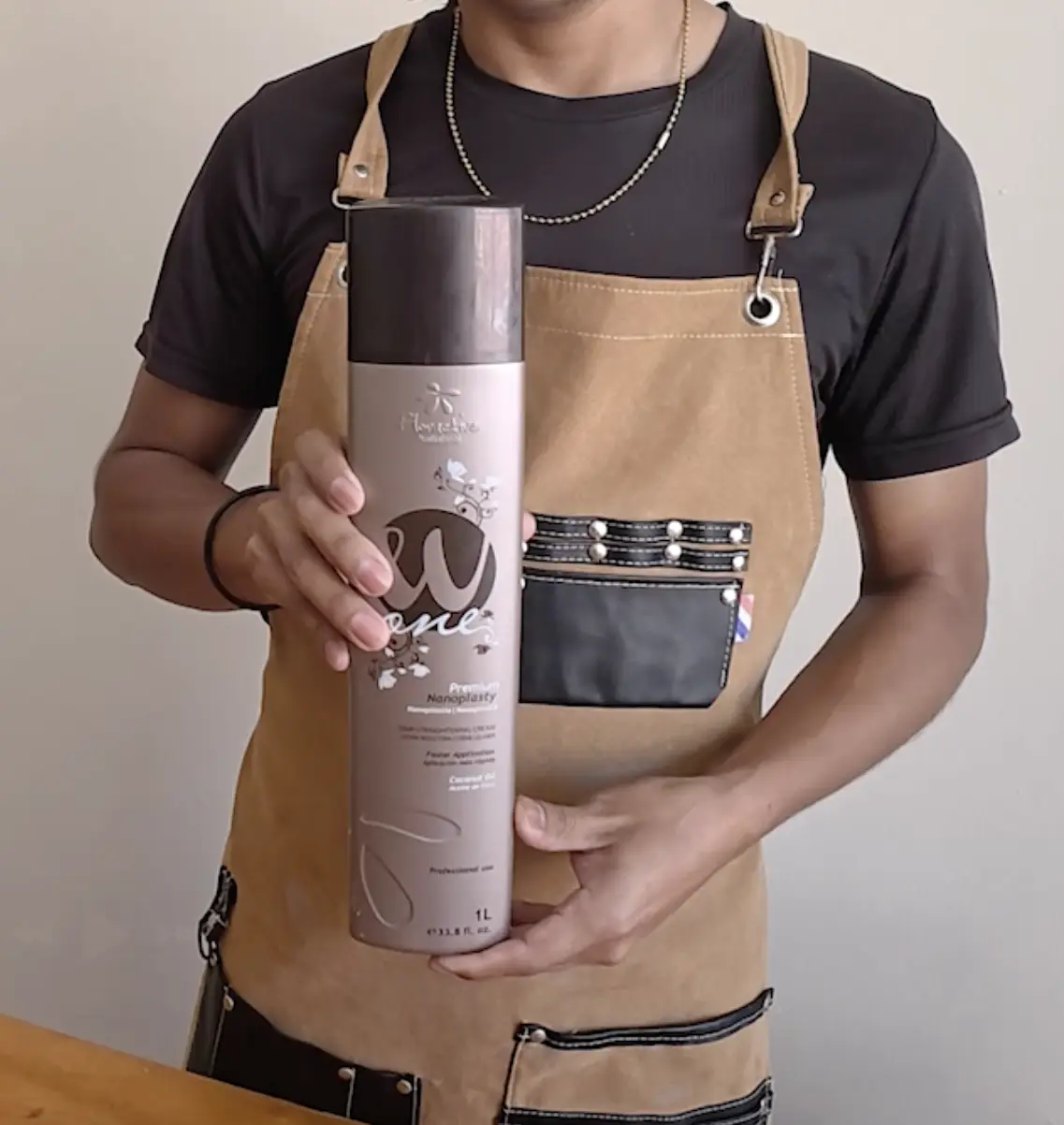
I'd already been going to the same stylists in Tulum for my hair, and they'd colored it approximately a month earlier. When I asked about nanoplastia, they recommended leaving some time between coloring and the smoothing treatment, so I waited before returning for the appointment.
The price was also a huge factor. My nanoplastia treatment cost 3,500 Mexican pesos, which at the time worked out to roughly $275 CAD or $200 USD. For someone who had repeatedly decided against professional smoothing treatments at home because of the cost, and the extra charge salons often add for hair as thick as mine, that suddenly felt reasonable enough to try.
If the treatment really meant I could stop straightening my hair every morning for several months, I wasn't just paying for smoother hair. I was buying back time.
What Happens During a Nanoplastia Treatment?
The appointment started with a wash followed by application of the nanoplastia formula throughout my hair. The product actually smelled surprisingly pleasant, and it was left on for around 40 minutes before being rinsed.
Then came the part I had seriously underestimated: the amount of blow-drying and flat-ironing involved. My hair is extremely thick, so even with two stylists working on it at the same time, this stage took close to two hours. Each section had to be carefully dried and straightened, and by that point I was settling into that strange salon-chair state where I somehow become incredibly sleepy despite people actively working around my head.
Afterward, my hair was washed again, a mask was applied for approximately five minutes, and then we went through another round of drying and styling before finishing with a small trim.
The entire appointment took approximately five and a half hours. My most practical advice if you have thick or long hair and are booking nanoplastia? Bring snacks! By the time we finished, it was completely dark outside, the nearby restaurants had closed, and my husband had already rescued me from a full hangry collapse with a protein bar midway through the appointment.
My Nanoplastia Before and After: The Immediate Result
Immediately after the treatment, my hair felt completely different. It was incredibly soft, silky, smooth, and noticeably lighter. The amount of bulk and frizz I normally deal with seemed dramatically reduced, and I walked out of the salon thinking this might be one of the best beauty treatments I'd tried in Mexico.
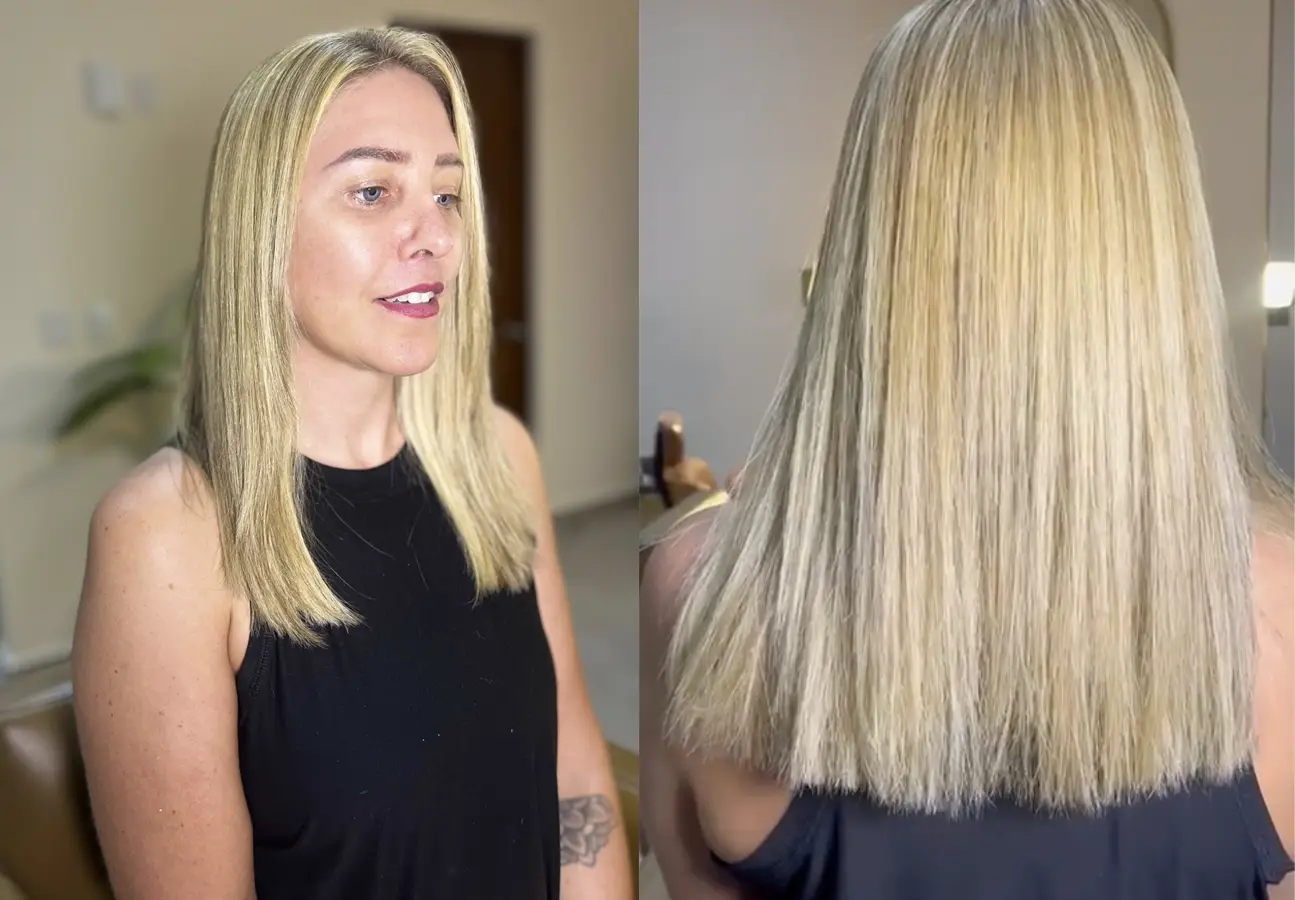
At that point, I was told the results could potentially last several months depending on my hair, maintenance, and aftercare. Considering what I'd paid and how much time I normally spend straightening my hair, the math felt pretty compelling. Then I washed it myself. That's when the real review began.
Why My Hair Turned Yellow After Nanoplastia
One thing I noticed immediately after my nanoplastia treatment was that my blonde hair looked considerably more yellow. Thankfully, I'd already read that smoothing and heat-intensive treatments can sometimes affect the appearance of color-treated hair, so I wasn't completely caught off guard. Over the following week, I used purple shampoo a couple of times to tone some of that warmth back down.
If you have blonde, highlighted, or color-treated hair, this is definitely something I'd discuss with your stylist before booking. Ask how the specific formula and heat process they use could affect your existing color and whether they recommend coloring your hair before or after the treatment.
My Nanoplastia Results 9 Days Later
Nine days after my treatment, I filmed my first real follow-up with no styling products in my hair. My initial verdict was still mostly positive, although by then I could already see some limitations. The top layer of my hair remained significantly smoother, but underneath, where my hair is naturally much thicker and has more curl, I could tell that I would still need to straighten certain areas occasionally. I'd also started seeing a slight dent from wearing my hair in a ponytail.
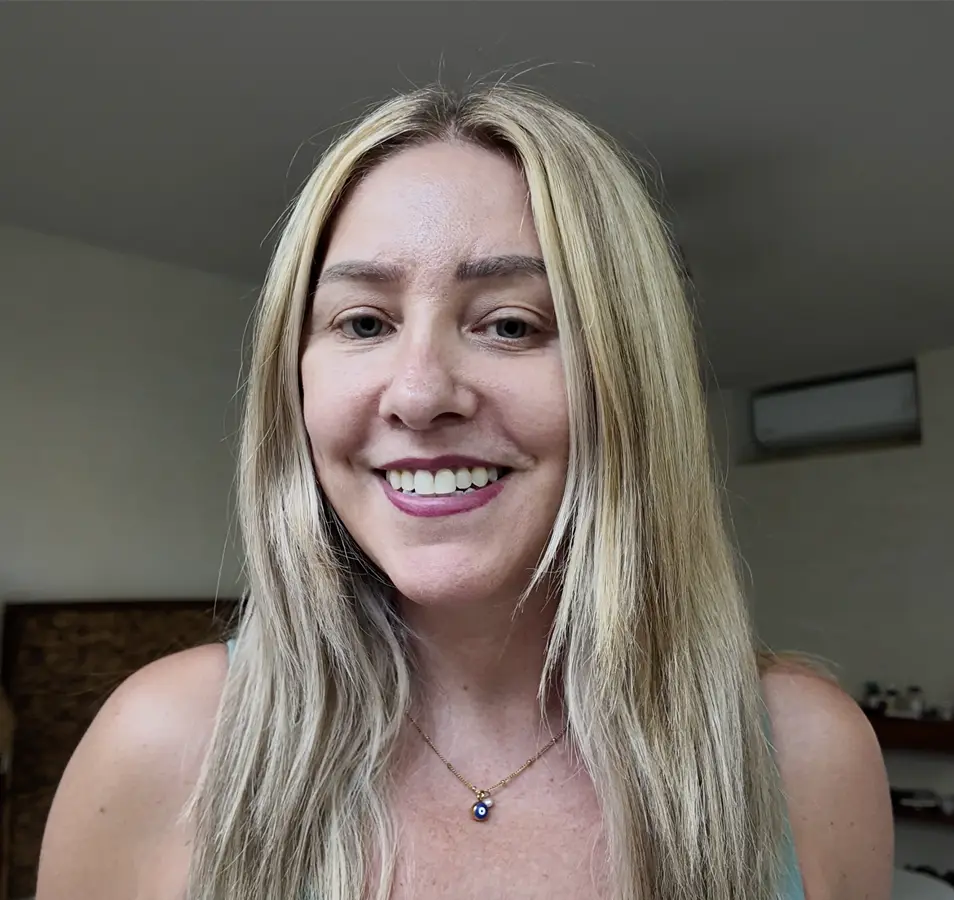
That mattered because one of the biggest reasons I'd wanted the treatment was convenience. If I still had to straighten the underneath layers and carefully manage how I tied my hair back, the result wasn't quite as effortless as I'd imagined on day one. At nine days, though, I still thought the treatment had potential. Three months later, my opinion changed.
My Nanoplastia Results After 3 Months
This is the part of the review I think matters most. If I'd published this article after my first week, I probably would have told you I loved nanoplastia.
At three months, I wouldn't say the same thing. My hair was still soft, which I appreciated, but the smoothing effect hadn't held up the way I'd hoped, particularly in the thick layers underneath the surface.
I followed the aftercare I had been given, used the products the salon sent me home with, and even stayed out of pools and the ocean during that period. Despite that, the underneath layers of my hair gradually returned much closer to their natural texture. The ponytail dent also continued to be an issue, even when I used hair ties designed to minimize creasing.
This is why I think long-term nanoplastia before-and-after results matter so much more than the glossy photo you take before leaving the salon. My immediate transformation was impressive. My three-month result was much less dramatic.
How Long Did Nanoplastia Last on My Hair?
For my hair, the strongest straightening and smoothing effect didn't last anywhere near as long as I'd hoped. That doesn't necessarily mean nanoplastia won't last long for everyone. My hair is unusually thick, has significant volume underneath, contains some natural curl, and is frequently tied back. All of those things are part of my individual experience, and someone with finer or more uniformly frizzy hair could have a completely different result.
This is also why I'd be cautious whenever you see a salon promise that nanoplastia will last a specific number of months. Instead, I'd ask: How long does this usually last on someone with my exact hair type? Show the stylist your natural hair, including what's happening underneath the top layer, rather than arriving with it freshly straightened.
Is Nanoplastia Good for Thick Hair?
This is where my experience becomes particularly relevant. If you have very thick hair with substantial volume and curl underneath, I'd ask a lot of questions before assuming nanoplastia will give you months of completely straight hair. My top layers responded much better than the dense underneath layers, and those underneath sections were exactly where I wanted the treatment to make the biggest difference. In hindsight, I would have asked the stylist specifically how well the treatment tends to work on hair with my density, texture, and curl pattern, rather than focusing mostly on the dramatic before-and-after result. If your hair is finer, less dense, or primarily frizzy rather than curly underneath, your experience may be completely different.
Nanoplastia vs. Keratin: Why I Chose Nanoplastia
I hadn't previously tried a traditional keratin treatment, so I can't give you a firsthand comparison of the two. That's important to say because a lot of content online presents nanoplastia vs. keratin as though everyone using the terms is talking about identical formulas and processes. They're not necessarily. Nanoplastia appealed to me because of how it was described by the salons I encountered in Mexico and because I wanted a smoothing treatment that could potentially reduce my dependence on daily heat styling.
If you're choosing between nanoplastia, keratin, Brazilian blowouts, or another smoothing treatment, I'd ask the stylist about the specific products they're using, ingredients, expected result on your hair type, effect on your hair color, maintenance requirements, and how straight versus simply less frizzy you should realistically expect your hair to become. That conversation is probably more useful than choosing based on the treatment name alone.
How Much Did My Nanoplastia Treatment Cost in Mexico?
I paid 3,500 pesos, approximately $275 CAD or $200 USD at the time, for my nanoplastia treatment in Tulum. Prices can obviously vary based on the salon, city, hair length, hair density, products used, and stylist, so I'd treat my price as one example rather than a standard rate for Mexico. The affordability was absolutely part of what made me willing to experiment.
Even though I ultimately wouldn't repeat the treatment at that price based on how long the results lasted for my hair, I'm still glad I tried it. That's one of the things I enjoy about exploring beauty treatments in Mexico and while I travel: treatments that felt financially difficult to justify at home sometimes become accessible enough that I'm willing to actually experience them for myself and decide whether they're worth incorporating into my routine.
Is Nanoplastia Worth It? My Honest Answer
After living with the results for three months, my answer is: It depends heavily on your hair type and what you're expecting it to do. For someone with finer hair or primarily surface-level frizz, nanoplastia may be exactly the kind of treatment that makes styling easier and reduces the amount of heat you use regularly.
For my extremely thick hair, with a lot of volume and curl underneath, the results faded too quickly in the areas where I needed the treatment most. It simply didn't last, even when I diligently followed after care instructions.
The whole process makes the five-and-a-half-hour appointment and cost harder for me to justify repeating. I also think there's an important distinction between saying: “My hair still feels better.” and “I no longer need to straighten my hair.” The first was true for me. The second wasn't. That distinction probably determines whether I'd consider nanoplastia worth it. So, at the end of the day I would not repeat. Instead I went to another hair stylist who did massive amounts of thinning, no other hair stylist dared to do, and that gave me much better results that I'm happy with.
Questions I'd Ask Before Booking Nanoplastia
If I were booking another nanoplastia appointment, these are the questions I'd ask first:
- What exact nanoplastia product and formula do you use?
- Can I see the ingredient list?
- How does it usually perform on extremely thick hair like mine?
- Will it straighten my natural texture or primarily reduce frizz?
- Can I see healed or long-term results rather than only same-day photos?
- How could the treatment affect my hair color?
- What aftercare products do I need?
- How soon can I wash, tie back, swim, or color my hair?
- What result should I realistically expect after three months, or six months?
- Does my hair length or density change the price?
I think those answers would have given me a much better idea of what I was actually buying.
Frequently Asked Questions About Nanoplastia
What is nanoplastia?
Nanoplastia is a professional salon treatment marketed for smoothing hair, reducing frizz, and making hair more manageable. The specific ingredients and process can vary by brand and salon, so I recommend asking what exact product your stylist uses rather than assuming all nanoplastia treatments are identical.
How long does nanoplastia last?
You'll see salons advertising results lasting six months, but longevity depends on the formula, hair type, washing routine, aftercare, heat styling, swimming, and other factors. On my extremely thick hair, the strongest smoothing effect had faded considerably in the underneath layers by two months.
Did nanoplastia completely straighten my hair?
Not permanently, and not evenly. My top layers became significantly smoother, but the thick, naturally curlier sections underneath started returning much sooner than I expected.
Did nanoplastia damage my blonde hair color?
My hair looked noticeably more yellow immediately after my treatment, although I was able to tone much of that warmth with purple shampoo. Anyone with blonde or color-treated hair should discuss potential color changes with their stylist before treatment.
How much did nanoplastia cost me in Mexico?
I paid approximately 3,500 Mexican pesos, which was around $275 CAD or $200 USD at the time. Pricing varies considerably by location, salon, stylist, hair length, and density.
How long did my nanoplastia appointment take?
My appointment took approximately five and a half hours, largely because my hair is extremely thick and required a significant amount of drying and straightening.
Would I recommend nanoplastia for thick hair?
I'd recommend approaching it with realistic expectations. My hair remained softer, but the straightening effect didn't last as well in my thick underneath layers as I had hoped. Someone with a different hair type may have a very different experience.
Would I get nanoplastia again?
Based on my three-month results, I probably wouldn't repeat the same treatment at the same price for my current hair type. I'm still glad I tried it because I now know how my particular hair responds rather than relying on someone else's before-and-after photos.
My Final Nanoplastia Review
My nanoplastia before-and-after transformation looked fantastic when I left the salon, and during that first week I genuinely thought I'd found a way to stop fighting my hair every morning. Three months later, the reality was more complicated. My hair remained softer and easier to manage in some areas, but the thick underneath layers didn't stay as straight or smooth as I'd expected, despite following my aftercare and avoiding pools and the ocean.
That's why my final review isn't that nanoplastia “doesn't work.” It's that nanoplastia didn't work well enough for my particular hair type to justify repeating it.
If you're considering the treatment yourself, don't just ask how long nanoplastia can last. Ask how it typically performs on hair that actually looks and behaves like yours. That's the question I wish I'd asked before spending five and a half hours in the salon chair.
This article documents my personal experience with a nanoplastia hair treatment. Products, ingredients, techniques, results, longevity, and individual sensitivities vary, so ask your stylist about the specific formula being used and whether it's appropriate for your hair and scalp.