

.svg)
HEALTH TREATMENTS
Turkey vs. Mexico Medical Tourism: Which Is Better?
Turkey or Mexico for medical tourism? Compare travel, costs, procedures, recovery, follow-up care and safety to decide which destination makes sense for you.
If you've been researching medical tourism in Turkey vs. Mexico, you've probably wondered which country is actually the better choice. Both have become popular destinations for people traveling abroad for medical and cosmetic procedures, but choosing between them involves a lot more than comparing the first prices you find online.
The biggest thing I've learned while researching medical tourism is that there really isn't one "best" country for everyone. The better question is: Which destination makes the most sense for your specific procedure, budget, travel tolerance, recovery needs, and ability to return for follow-up care?
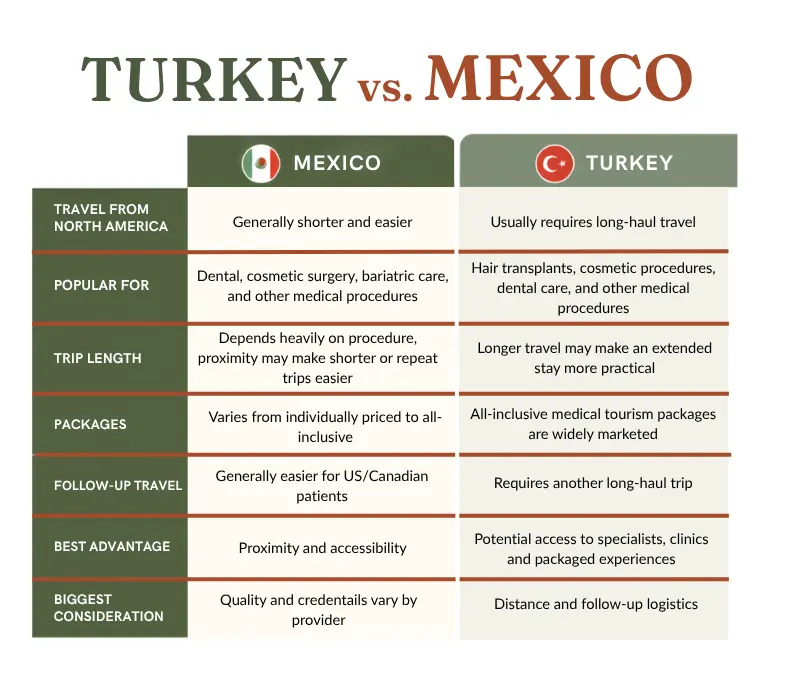
For someone traveling from the United States or Canada, Mexico's biggest advantage can be proximity, while Turkey may be worth considering if you've found a particular surgeon, clinic, treatment, or package that makes the longer journey worthwhile. The quality of your care ultimately depends much more on the specific doctor and medical facility you choose than the country itself.
Here's how I would compare Turkey vs. Mexico for medical tourism before deciding where to go.
Prefer to watch? In this video, I break down the key differences between medical tourism in Turkey and Mexico, including costs, travel, procedures, recovery, and follow-up care, to help you decide which destination might be the better fit for you.
This isn't a ranking of medical quality. Excellent, and poor providers can exist anywhere, which is why I would never choose a country first and assume that automatically means I've found the right surgeon.
Location and Travel: Mexico Has a Major Advantage for North Americans
For me, this is one of the biggest differences between medical tourism in Mexico and Turkey because travel doesn't end once you've arrived for your procedure.
Turkey is a significant journey from North America, which means long flights, jet lag, more complicated travel logistics, and potentially needing to build additional recovery time into the trip before you're medically cleared to fly home.
Mexico is considerably more accessible for most Americans and Canadians. Depending on where you live and where you're receiving treatment, you may have relatively short direct flights, and some US patients receiving treatment in Mexican border cities can even drive or walk across the border.
That proximity can matter even more after the original procedure. If you need another in-person appointment several weeks or months later, getting back to Mexico may be considerably easier and less expensive than making another trip to Turkey.
If extended time away from home or work isn't realistic, or the thought of recovering after a procedure and then taking a long-haul flight sounds miserable, Mexico may have a significant logistical advantage. If you've found a specific provider in Turkey whose expertise makes the longer trip worthwhile, however, distance may be a trade-off you're willing to make.
Medical Facilities: Compare the Hospital or Clinic, Not Just the Country
One thing I'd be careful about when comparing medical tourism destinations is assuming that one country's hospitals or technology are automatically better than another's.
Both Turkey and Mexico have private hospitals, specialty clinics, cosmetic surgery centers, dental facilities, and providers serving international patients. The experience can range from a smaller specialty practice to a large hospital with extensive diagnostic and surgical capabilities.
For that reason, I wouldn't choose Turkey because someone told me it has "better hospitals," and I wouldn't choose Mexico simply because I've seen a beautiful clinic on Instagram.
I'd research the actual facility where my procedure will take place.
For surgery, I want to know whether the facility is appropriately licensed, what type of emergency resources are available, who administers anesthesia, where I would be transferred if something went wrong, and whether the facility is equipped for the procedure I'm having.
This is especially important with cosmetic surgery in Mexico. Mexican health authorities have specific requirements for facilities performing aesthetic surgical procedures, including requirements involving licensing, infrastructure, equipment, surgical personnel, anesthesia, and arrangements for higher-level care when necessary.
A luxury recovery suite is nice. A properly equipped surgical facility is considerably more important.
What Procedures Are Mexico and Turkey Known For?
This is probably where you've seen the biggest generalizations online.
Turkey has become especially well known internationally for hair transplantation, cosmetic procedures, and dental treatment, and you'll find an enormous number of clinics marketing packages specifically to international patients.
Mexico has a long-established medical tourism industry as well, particularly among American and Canadian patients. Dental treatment has historically been a major part of that market, alongside plastic surgery and a wide range of other medical specialties.
The mistake I wouldn't make is deciding, for example, that "Turkey is best for plastic surgery" or "Mexico is best for dental work" and stopping the research there.
If I wanted a facelift, I'd rather have an exceptional facelift surgeon in Mexico than an average facelift surgeon in Turkey simply because Turkey appeared on someone's list of the "best countries for cosmetic surgery." The same logic applies in reverse.
Choose the specialist first, then evaluate whether traveling to that specialist's country makes sense.
Turkey vs. Mexico Medical Tourism Costs
Cost is obviously one of the reasons people start researching medical tourism in the first place.
Mexico's tourism authorities have historically cited significant savings on medical treatment compared with US pricing, particularly in areas including dentistry and plastic surgery. For a North American patient, Mexico can also have another financial advantage that doesn't appear on a surgeon's quote: getting there may cost considerably less.
Turkey is widely known for medical-tourism packages that may combine treatment with accommodations, transfers, coordinators, and other services. That can make planning easier, especially when you're traveling such a long distance.
This is why I never compare only the procedure price.
Instead, I want to calculate the real cost of medical tourism, including:
- Procedure or treatment
- Anesthesia
- Hospital or surgical facility fees
- Pre-operative testing
- Medications
- Flights
- Hotel or recovery accommodation
- Ground transportation
- Nursing or caregiver support
- Post-operative treatments or massages
- Food and everyday expenses
- Time away from work
- Follow-up appointments
- A potential return trip
- Possible revision-related expenses
A $5,000 procedure isn't really a $5,000 procedure if the entire trip ultimately costs $9,000.
Recovery and Follow-Up: The Part People Forget to Compare
This has become one of the biggest factors I consider when looking at medical tourism because your relationship with your surgeon doesn't necessarily end when you get on the plane.
Before traveling anywhere for a procedure, I want to know how long I need to remain near my surgeon, how many in-person follow-ups are expected, when I'm medically cleared to travel, and what happens once I'm back home.
If I have a concern two weeks later, who do I contact? Will the surgeon review photos or speak with me remotely? If I develop a complication, am I expected to see a doctor at home? What happens if I need to be examined by the original surgeon again?
Distance changes the answer to all of those questions.
This is where Mexico has a practical advantage for many North American patients. If I need to return three or six months later, another trip to Mexico may be relatively manageable, while returning to Turkey requires another substantial international journey.
That doesn't make Mexico medically "better." It simply means follow-up logistics deserve to be part of your decision from the beginning.
What Happens if You Need a Revision?
If you're traveling for cosmetic surgery in particular, ask about revisions before you book the original procedure.
I've personally had cosmetic procedures that required some type of revision, so this isn't a hypothetical consideration for me. Your surgeon should explain what they consider a revision, when they would evaluate the final result, whether they charge another surgical fee, and what other expenses you could potentially be responsible for.
Even if a surgeon waives their own fee, you could still have anesthesia, facility, medication, hotel, airfare, and time-off-work expenses.
This is another reason proximity matters to me.
A surgeon thousands of miles away might be fantastic, but I still want to ask myself: If I have to come back here twice, does this decision still make sense?
Patient Experience: Don't Confuse Medical Tourism With Vacation
Turkey's medical tourism industry is known for heavily marketed package experiences that can include airport pickup, hotel accommodations, translators or coordinators, and transportation between appointments. That structure can be appealing when you're arriving somewhere unfamiliar and don't want to organize every part of the trip yourself.
Mexico offers concierge and luxury medical tourism experiences as well, and for North Americans there may also be greater geographic and cultural familiarity depending on where you're traveling.
Personally, I think it's easy to get distracted by this part.
A gorgeous hotel, private driver, ocean view, or luxury recovery house can make the experience more comfortable, but none of those things tell me whether the person operating on me is qualified or whether the facility is appropriate.
I research the medical care first and the experience second.
Safety: Is Turkey or Mexico Safer for Medical Tourism?
I don't think this question can responsibly be answered with a simple country-versus-country ranking.
Medical tourism has risks regardless of destination, and your safety depends on factors including your health, the procedure, surgeon qualifications, facility standards, anesthesia, infection prevention, post-operative care, travel timing, and what happens if a complication develops.
For Mexico specifically, the country's tourism guidance says medical specialists participating in medical tourism should have applicable current certifications, while Mexican health regulators have also published requirements for facilities performing aesthetic surgery.
That reinforces something I believe strongly: don't outsource your research to the reputation of a country.
Verify the individual doctor. Verify the facility. Understand the procedure. Ask about complications. Understand the aftercare plan.
That's true whether you're traveling to Mexico, Turkey, or anywhere else.
Turkey vs. Mexico: Which Would I Choose?
For someone traveling from the US or Canada, Mexico has a very compelling practical advantage because of its proximity. Shorter travel, potentially lower travel costs, and the ability to return more easily for follow-up care are meaningful benefits that I don't think should be underestimated.
Turkey becomes compelling when you've identified a specific surgeon, treatment, clinic, or expertise that gives you a strong reason to make the longer journey, or when the overall treatment package makes sense for your particular situation.
I wouldn't choose either country because TikTok told me it was the place to go for a certain procedure, and I definitely wouldn't choose based on price alone.
My decision would come down to five questions:
- Who is the best qualified provider for the specific procedure I'm considering?
- Can I independently verify their credentials and the facility?
- What will the entire trip actually cost?
- How long do I need to stay nearby to recover safely?
- What happens if I need follow-up care or have to come back?
If Mexico wins those five questions, I'd choose Mexico. If Turkey wins them, I'd choose Turkey.
That's ultimately how I think medical tourism should be approached: not "Which country is best?" but "Which qualified provider, facility, and recovery plan are best for me?"
Frequently Asked Questions About Turkey vs. Mexico Medical Tourism
Is Mexico or Turkey cheaper for medical tourism?
It depends on the procedure and provider, so comparing advertised procedure prices alone isn't enough. For North American patients, Mexico may have an advantage in overall travel expenses because getting there and returning for follow-up can be easier, while some Turkish providers offer packages that bundle treatment, accommodations, transportation, and other services.
Is Turkey or Mexico better for cosmetic surgery?
I wouldn't choose based on the country alone. I'd compare surgeons who regularly perform the exact cosmetic procedure I'm considering, look at their long-term results, independently verify their credentials, research the surgical facility, and understand their complication and revision policies.
Is Mexico good for dental tourism?
Mexico has a substantial history of international dental tourism, particularly among patients traveling from the United States. As with any medical or dental treatment abroad, however, I'd research the individual dentist, credentials, facility, treatment plan, materials being used, and follow-up care rather than assuming every provider offers the same standard of care.
Is Turkey worth traveling to from the US or Canada for medical treatment?
It can be if you've identified a provider or treatment that makes the longer trip worthwhile. I would factor the flight time, length of stay, recovery before flying, total travel costs, and possibility of needing to return into the decision before booking.
What should I research before booking medical tourism?
Start with the provider's qualifications and experience with your specific procedure, then research the facility, complication plan, expected recovery, total costs, aftercare, and what happens if you need additional treatment once you've returned home.
What to Research Before You Book Medical Tourism
Once you've narrowed down the country, the next step is researching the actual person who will be treating you.
If you're considering Mexico, start with my guide on [How to Verify a Board-Certified Plastic Surgeon in Mexico] [LINK], where I walk through the credential checks I use before considering a surgeon.
Then read [10 Questions I Wish I'd Asked Before My First Cosmetic Procedure] [LINK] before your consultation. Those questions cover the things I've learned to ask about experience, complications, recovery, results, and revisions after going through multiple cosmetic procedures myself.
The destination might be what starts your medical tourism research, but the provider is ultimately where I'd spend most of my time investigating.
This article is intended for general informational purposes and reflects my personal approach to researching medical tourism. It is not medical advice and does not recommend one country, provider, or procedure over another. Medical procedures and international travel carry risks, and individual circumstances vary. Verify current credentials and facility requirements with the appropriate authorities and discuss your individual health, procedure, travel plans, and recovery with qualified healthcare professionals.