


.svg)
HEALTH TREATMENTS
Best Countries for Medical Tourism in 2026: Top 5
A comparison of the best countries for medical tourism in 2026, including what each destination is known for and what to consider before traveling abroad for healthcare.
Best Countries for Medical Tourism in 2026: 5 Destinations Worth Considering
If you still think medical tourism is simply about finding the cheapest healthcare abroad, that's not how I approach it in 2026. Cost absolutely matters, but so do the quality of the provider, safety standards, specialization, technology, travel logistics, recovery, and what happens when you return home.
I'll also be upfront about where I'm coming from. My firsthand experience so far has primarily been in Mexico, where I've explored beauty and wellness treatments and also had dental work, including a dental implant in Playa del Carmen. I'm actively expanding that research, with Turkey and Colombia among the destinations I plan to explore next.
For the countries I haven't personally visited for healthcare yet, I'm approaching this as research rather than pretending I have firsthand experience I don't have. As I visit more destinations, I'll continue updating these guides with what I actually find on the ground.
So, what are the best countries for medical tourism in 2026?
There isn't one country that's best for every patient or every procedure. Instead, I've ranked five of the most compelling established destinations based on the factors I think matter most: quality of care, areas of specialization, international-patient infrastructure, technology, accessibility, and the overall medical-tourism experience.
Prefer to watch? In this video, I break down five of the best countries for medical tourism in 2026, what each destination is known for, and the factors I'd consider before traveling abroad for healthcare.
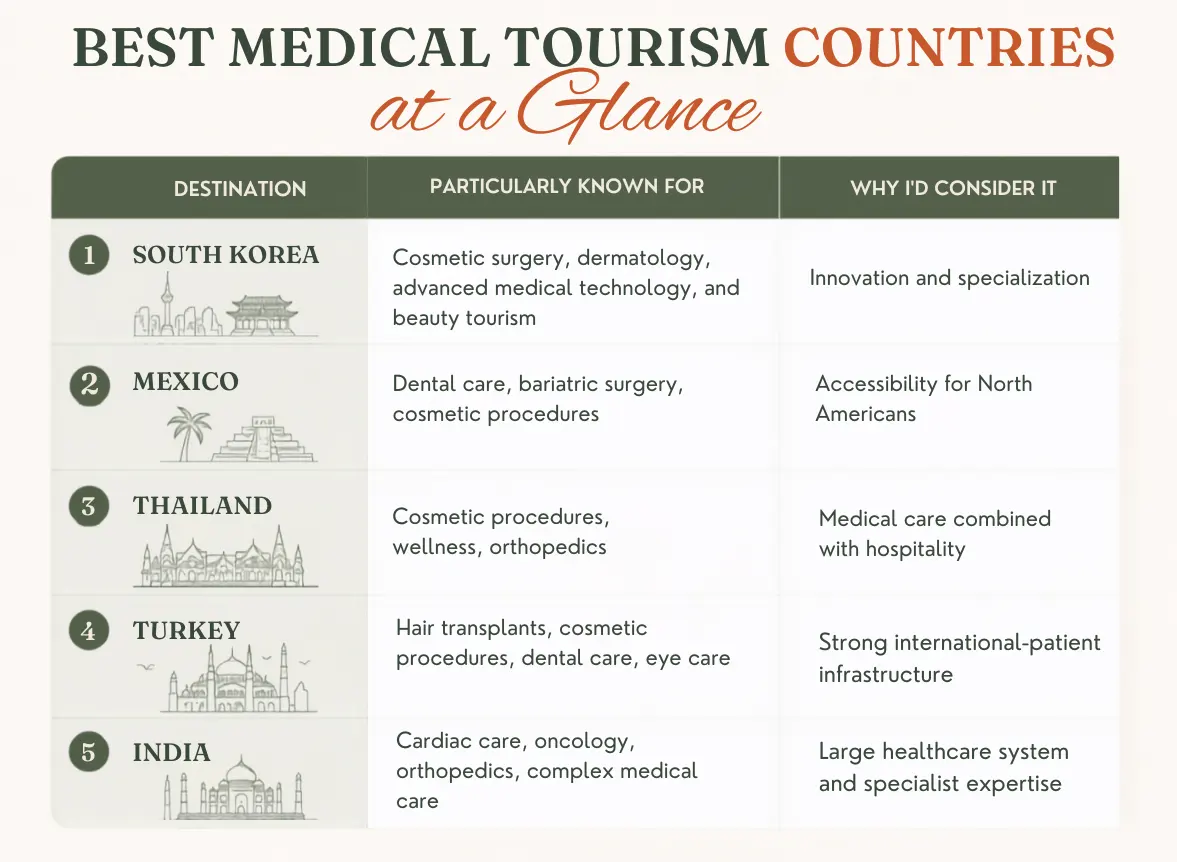
The important thing to remember is that a country's ranking should never substitute for researching the individual doctor, hospital, clinic, and procedure you're considering. An excellent provider in the country ranked fifth could be a far better choice for you than the wrong provider in the country ranked first.
5. India: A Major Destination for Complex Medical Care
India has a long-established medical tourism industry and is particularly worth researching for patients seeking more complex medical care. Large private hospital systems treat international patients across specialties including cardiology, oncology, orthopedics, neurology, and other advanced medical and surgical care.
One of India's biggest advantages is scale. Its large healthcare system includes major private hospitals with dedicated international-patient departments, and English is widely used within many private healthcare settings serving international patients.
For me, India belongs on this list for a different reason than destinations that have become famous primarily through cosmetic surgery or dental tourism. If I were researching a significant medical procedure rather than an elective beauty treatment, India would be one of the countries I'd want to investigate more closely.
Of course, "India" isn't a healthcare provider. I'd still want to compare the actual hospitals, physicians, credentials, outcomes, treatment plans, and follow-up care rather than assuming a country's reputation guarantees the experience I'll have.
4. Turkey: A Medical Tourism Destination I'm Researching Next
Turkey is next on my own research list, and I have a trip planned specifically so I can experience more of its medical-tourism and beauty ecosystem firsthand. Until I've actually been there, I want to be clear that my perspective on Turkey is based on research rather than personal experience.
I'm particularly interested in hair transplants, rhinoplasty, dermatology, eye care, dental treatment, and cosmetic procedures.
One thing that makes Turkey interesting from a medical-tourism perspective is how deliberately many providers cater to international patients. You'll find clinics marketing packages that can combine treatment with hotel accommodations, airport transfers, translators or coordinators, and transportation between appointments.
That convenience can be appealing when you're traveling halfway around the world for care because you're not trying to piece together every part of the trip yourself.
There's another side to that convenience, though. The popularity of medical tourism in Turkey means there are an enormous number of providers competing for international patients, particularly in highly marketed categories such as hair transplantation and cosmetic procedures.
For me, that makes provider research more important, not less.
I'm particularly interested to see how the polished online experience compares with the actual patient experience once I'm there.
3. Thailand: Medical Tourism Meets Wellness
Thailand has built an international reputation around something I find particularly interesting: the intersection between medical care, wellness, and hospitality.
Bangkok and other major destinations have private hospitals and specialty providers serving international patients, while Thailand's broader tourism infrastructure makes it relatively easy to build a longer recovery or wellness experience around a medical trip.
The country is frequently associated with cosmetic procedures, orthopedics, preventive health, wellness, and other elective treatments, although the available specialties extend well beyond those categories.
For someone who's already interested in wellness travel, Thailand is particularly intriguing because the medical treatment doesn't necessarily exist in isolation from the rest of the trip.
That's an area I want to explore much more deeply as my own content expands beyond beauty treatments and into longevity, preventive health, wellness destinations, and international healthcare.
2. Mexico: My Firsthand Medical Tourism Experience
Mexico is the destination on this list I can speak about most confidently from personal experience.
I've spent considerable time exploring beauty and wellness treatments there, including hair treatments, nails, Botox, CO2 laser treatments, facials, spa experiences, and permanent makeup. I've also crossed into actual medical tourism by having dental work done, including a dental implant in Playa del Carmen.
That firsthand experience is one of the reasons Mexico ranks so highly for me.
For Americans and Canadians, the obvious advantage is proximity. Depending on where you're going, Mexico can mean a relatively short direct flight rather than a long-haul international journey, and destinations such as Tijuana are accessible across the US-Mexico border.
That becomes particularly important when you start thinking beyond the original procedure.
What happens if you need another appointment three months later? What happens if you need a revision? What if your dentist wants to check something in person?
Getting home is part of medical tourism. Getting back is too.
Mexico is particularly well known among international patients for dental care, bariatric surgery, cosmetic procedures, and other elective treatments, with established medical-tourism markets in places including Tijuana, Cancún, and other major cities.
My experiences in Mexico have been positive overall, but that's also taught me not to make the mistake of assuming that "healthcare in Mexico" is one thing. I've encountered very different providers, facilities, price points, and experiences, which is why I research the individual practitioner rather than trusting the destination alone.
If you're considering cosmetic surgery specifically, I've also created a step-by-step guide explaining how I verify a plastic surgeon's credentials in Mexico before I consider booking.
1. South Korea: A Leader in Aesthetic Medicine and Medical Technology
South Korea takes the top spot on my list because of the combination of medical technology, specialization, aesthetic medicine, and the country's broader influence on the global beauty industry.
It's particularly associated internationally with plastic surgery and dermatology, and the popularity of Korean skincare and K-beauty has made the country's aesthetic industry familiar even to people who have never considered traveling there for treatment.
What interests me most, though, isn't simply cosmetic surgery.
South Korea is also an interesting destination to watch for the integration of advanced diagnostics, technology, preventive health, and highly specialized medical services. For someone interested in where beauty, longevity, preventive medicine, and technology intersect, that's particularly compelling.
Would I book a procedure simply because a clinic is in South Korea? Absolutely not.
I'd apply exactly the same research standards there that I would in Mexico, Turkey, Canada, or anywhere else: verify the provider, understand the facility, research their experience with my specific procedure, ask about complications, understand the recovery plan, and figure out what happens once I'm thousands of miles away again.
That's ultimately why South Korea is #1 on my research list, rather than a declaration that every patient should choose South Korea over every other country.
Emerging Medical Tourism Destinations to Watch
The five countries above have well-established international healthcare markets, but they're not the only places worth watching.
Several destinations are becoming increasingly interesting for particular procedures, geographic markets, or types of patients.
Colombia
Colombia is another destination I plan to research firsthand, particularly around aesthetic medicine, dentistry, dermatology, wellness, and beauty treatments.
Cities such as Bogotá and Medellín have developed substantial private healthcare and aesthetic industries, and Colombia's reputation for cosmetic procedures has made it increasingly visible among North American medical tourists.
I'm especially interested in looking beyond cosmetic surgery to see what's happening in preventive health, regenerative medicine, longevity, and wellness.
Once I've actually visited providers and experienced some of this ecosystem myself, I'll update my Colombia coverage with what I find rather than relying solely on online research.
Costa Rica
Costa Rica is particularly interesting for North Americans because it combines relative geographic accessibility with a well-established tourism industry.
It's frequently considered for dental care, cosmetic procedures, and other elective treatments, while the country's broader reputation for nature and wellness gives it an obvious appeal for people who want to incorporate recovery into a longer trip.
As with every destination on this list, however, a beautiful recovery environment isn't a substitute for researching the healthcare itself.
Malaysia
Malaysia is another Asian medical-tourism destination worth watching, with private healthcare serving international patients across a range of specialties.
It may not have the same social-media visibility in North America as Thailand or South Korea, but that's actually part of what makes it interesting to me. Some of the most worthwhile medical-tourism destinations aren't necessarily the ones dominating TikTok.
Croatia and Serbia
Within Europe, countries including Croatia and Serbia have attracted patients seeking dental treatment, orthopedics, and elective procedures, particularly from elsewhere in Europe.
Their value proposition is somewhat different for someone traveling from North America because geography becomes a bigger consideration, but they're useful examples of how medical tourism isn't exclusively about Americans and Canadians traveling abroad.
There's an enormous amount of regional medical travel happening around the world as patients cross nearby borders for greater availability, different specialists, or lower costs.
Egypt
Egypt is another destination worth watching, particularly within Africa and the Middle East.
Its large healthcare system and medical universities support specialties ranging from orthopedics and cardiology to fertility care and dentistry, while private healthcare providers in major cities serve both domestic and international patients.
For someone traveling from Canada or the United States, Egypt may not be the most obvious medical-tourism choice simply because of the distance. For patients elsewhere in Africa, the Middle East, or parts of Europe, however, the geography looks completely different.
That's another reason I think "best country for medical tourism" always needs context.
What Is Changing in Medical Tourism in 2026?
The part of medical tourism I'm most interested in isn't simply which country can offer a procedure for the lowest price.
It's what happens before and after the procedure.
Can you have a video consultation before flying across the world? Can you access your medical records afterward? Who answers your questions when you're back home? Can your surgeon evaluate you remotely? Is there a clear plan if something goes wrong? Can care be coordinated with a healthcare provider where you live?
Those questions become increasingly important as more people cross borders for medical and cosmetic care.
Technology makes it easier than ever to find a doctor on the other side of the world, but that doesn't automatically solve one of medical tourism's biggest challenges: continuity of care once you come home.
How to Choose the Best Country for Medical Tourism for You
Instead of asking only, "What's the best country for medical tourism?", I'd start with a different set of questions:
- What procedure or treatment am I actually seeking?
- Which providers specialize in that procedure?
- Can I independently verify their credentials?
- What facility will the procedure take place in?
- What does the total trip cost—not just the procedure?
- How long do I need to stay after treatment?
- When is it medically appropriate for me to travel home?
- What follow-up care will I need?
- What happens if I develop a complication after returning home?
- How difficult and expensive would it be to return to the provider?
The answers may lead you to Mexico, South Korea, Turkey, Thailand, India—or somewhere that isn't on this list at all.
So, What Is the Best Country for Medical Tourism in 2026?
My current list is South Korea, Mexico, Thailand, Turkey, and India, but I don't consider that a universal prescription for where anyone should receive healthcare.
Think of it as a starting point for your research.
Mexico currently stands out to me because I've actually experienced its beauty and healthcare ecosystem firsthand, while South Korea is particularly compelling for the intersection of aesthetics, technology, and advanced medicine. Turkey is high on my list to investigate in person next, and Colombia is one of the emerging destinations I'm especially interested in exploring.
The more I research medical tourism, the less interested I become in simply finding the cheapest destination.
I want to know who is doing the procedure, how experienced they are, where they're doing it, what happens if something goes wrong, how recovery is handled, and whether I can realistically access that provider again after I return home.
That's ultimately what I think smarter medical tourism looks like in 2026.
Frequently Asked Questions About Medical Tourism
What are the best countries for medical tourism in 2026?
South Korea, Mexico, Thailand, Turkey, and India are among the destinations I think are most worth researching, although the best country depends heavily on the specific procedure, provider, budget, location, and follow-up care you need.
What is the best country for cosmetic surgery abroad?
There isn't one country I'd recommend universally for cosmetic surgery. Countries including South Korea, Mexico, Turkey, Thailand, and Colombia have significant aesthetic medicine industries, but I'd choose based on the individual surgeon's qualifications, experience, results, facility, and aftercare rather than the country's reputation alone.
What is the best medical tourism destination for Americans and Canadians?
Mexico has an obvious logistical advantage because of its proximity to the US and Canada. Shorter travel and the relative ease of returning for follow-up care can make it particularly practical, although that doesn't mean every Mexican provider is appropriate for every patient or procedure.
Is medical tourism cheaper than healthcare in the US or Canada?
Cost savings are one reason people consider medical tourism, but they vary significantly by country, procedure, provider, and individual circumstances. I recommend comparing the total cost of the trip, including treatment, flights, accommodation, transportation, aftercare, time away from work, and the possibility of needing to return.
How do I know whether a medical tourism provider is safe?
I don't assume a provider is safe simply because they're located in a country with a strong medical-tourism reputation. I independently research credentials, experience with the specific procedure, the facility, complication protocols, aftercare, patient experiences, and what happens if additional treatment is needed.
Where to Start Your Medical Tourism Research
If you're considering Mexico for cosmetic surgery, start with my guide to How to Verify a Board-Certified Plastic Surgeon in Mexico
If you've already found a provider and are preparing for a consultation, read 10 Questions I Wish I'd Asked Before My First Cosmetic Procedure
You can also read my Turkey vs. Mexico for Medical Tourism comparison if those are the two destinations you're currently considering.
I'll continue adding firsthand guides as I explore more of these destinations myself, because there's a big difference between researching medical tourism from your laptop and actually getting on the plane, walking into the clinic, and experiencing the system as a patient.
This article combines my personal experiences with general medical-tourism research and is intended for informational purposes only. It is not medical advice or a recommendation to seek treatment in any particular country. Healthcare standards, regulations, credentials, risks, and individual circumstances vary significantly by provider and destination. Independently verify your healthcare provider and facility and discuss medical decisions and travel plans with appropriately qualified healthcare professionals.