

.svg)
COSMETIC SURGERY
How to Verify a Board-Certified Plastic Surgeon in Mexico: A Step-by-Step Guide
A step-by-step guide to verifying a plastic surgeon’s credentials in Mexico, spotting red flags, and doing your research before booking cosmetic surgery.
If you're considering plastic surgery in Mexico, whether that's in Tijuana, Guadalajara, Cancún, Mexico City, or somewhere else, verifying your surgeon's credentials should be one of the first things you do before paying a deposit or booking a procedure.
One of the most important things I've learned while researching cosmetic surgery in Mexico is that seeing someone's medical credentials isn't the same thing as confirming that they're a certified specialist in plastic, aesthetic, and reconstructive surgery. A professional medical license and specialty certification tell you different things, which is why I don't rely on a clinic's website, Instagram bio, or the word "surgeon" alone when I'm researching someone who could potentially operate on me.
Mexico has an official system that allows you to check professional credentials, and the Consejo Mexicano de Cirugía Plástica, Estética y Reconstructiva (CMCPER) maintains a directory where patients can verify certified plastic surgeons. The CMCPER states that it is the certifying body for plastic, aesthetic, and reconstructive surgeons in Mexico and that certified surgeons undergo recertification every five years.
The good news is that you can do much of this research yourself online before you ever walk into a consultation.
Here's the step-by-step process I use to verify a plastic surgeon in Mexico, followed by some additional research I do before deciding whether I'm comfortable booking a consultation or procedure.
Prefer to watch? In this video, I walk you through the exact steps I use to verify a plastic surgeon’s credentials in Mexico before I consider booking a procedure.
Step 1: Verify the Doctor's Professional Credentials in Mexico
The first place I start is with the doctor's Cédula Profesional, or professional license.
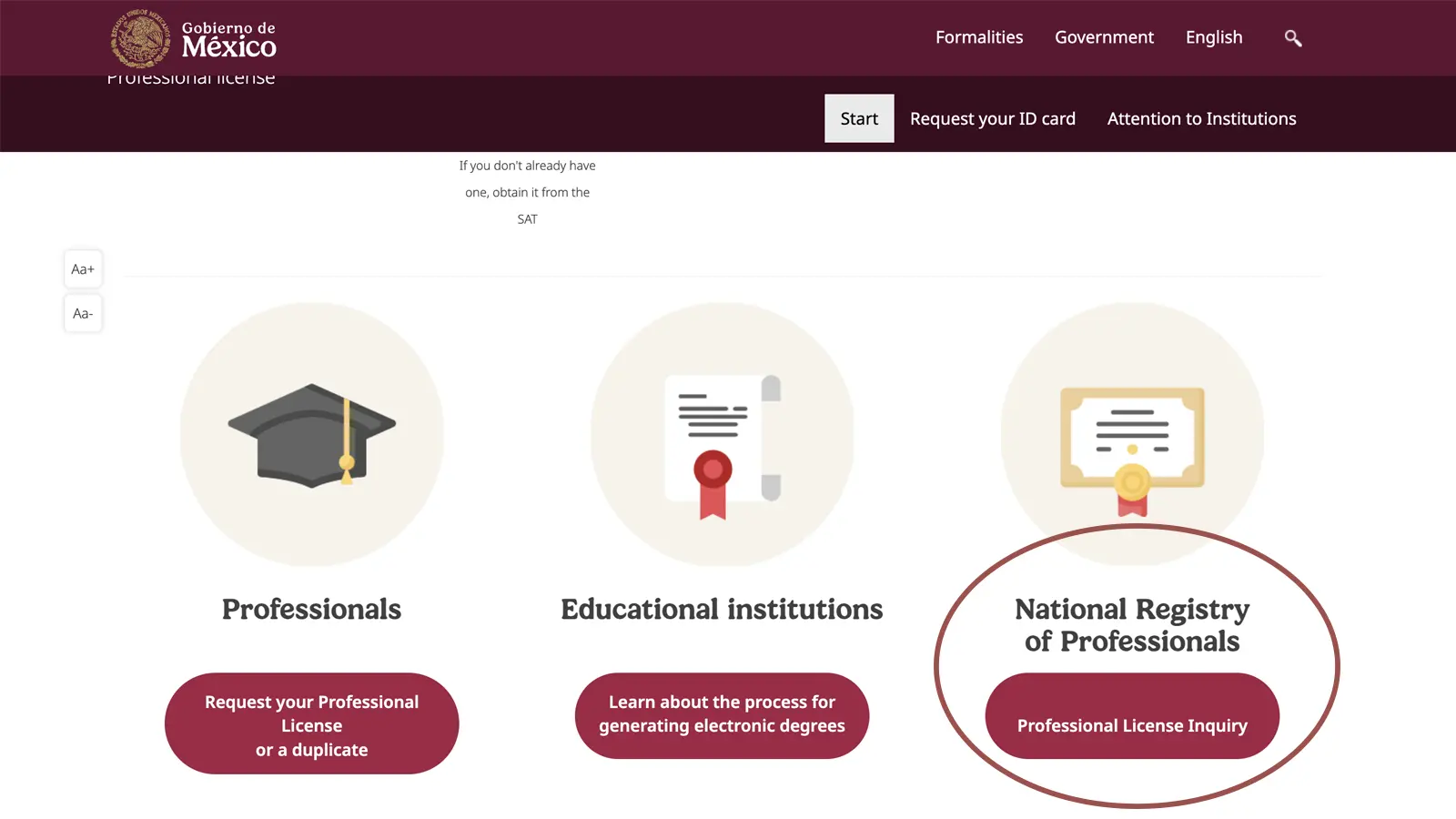
Mexico's Secretaría de Educación Pública (SEP) provides an official system for professional credentials, which allows you to check the validity of a professional cédula. This is an important first step because I want to verify someone's credentials through an official source rather than simply trusting the information provided by the surgeon or clinic.
You can search for this directly through Mexico's government registry, the National Registry of Professionals, under "professional license inquiry." You can search by full name, but I'd strongly recommend searching by ID number instead if you have it, since a name search can return five pages of results or more, especially for common names. Once you find the right entry, you'll see their degree, where they studied, the year they graduated, and you can even download a PDF of their certification directly. Check that the full name matches exactly, that the degree reflects actual medical training, that a university is listed, and that there's a clear issue date.
Here's the important caveat: a cédula confirms someone is a licensed physician. It does not confirm they're a board-certified plastic surgeon. Think of it like a driver's license, it proves someone can legally drive, not that they're qualified to be behind the wheel of a race car.
When researching a doctor, make sure you're looking at the correct person and compare the information you find with the full legal name and credentials the clinic has provided.
Step 2: Verify the Plastic Surgeon Through the CMCPER
This is the step I consider especially important when researching board-certified plastic surgeons in Mexico.
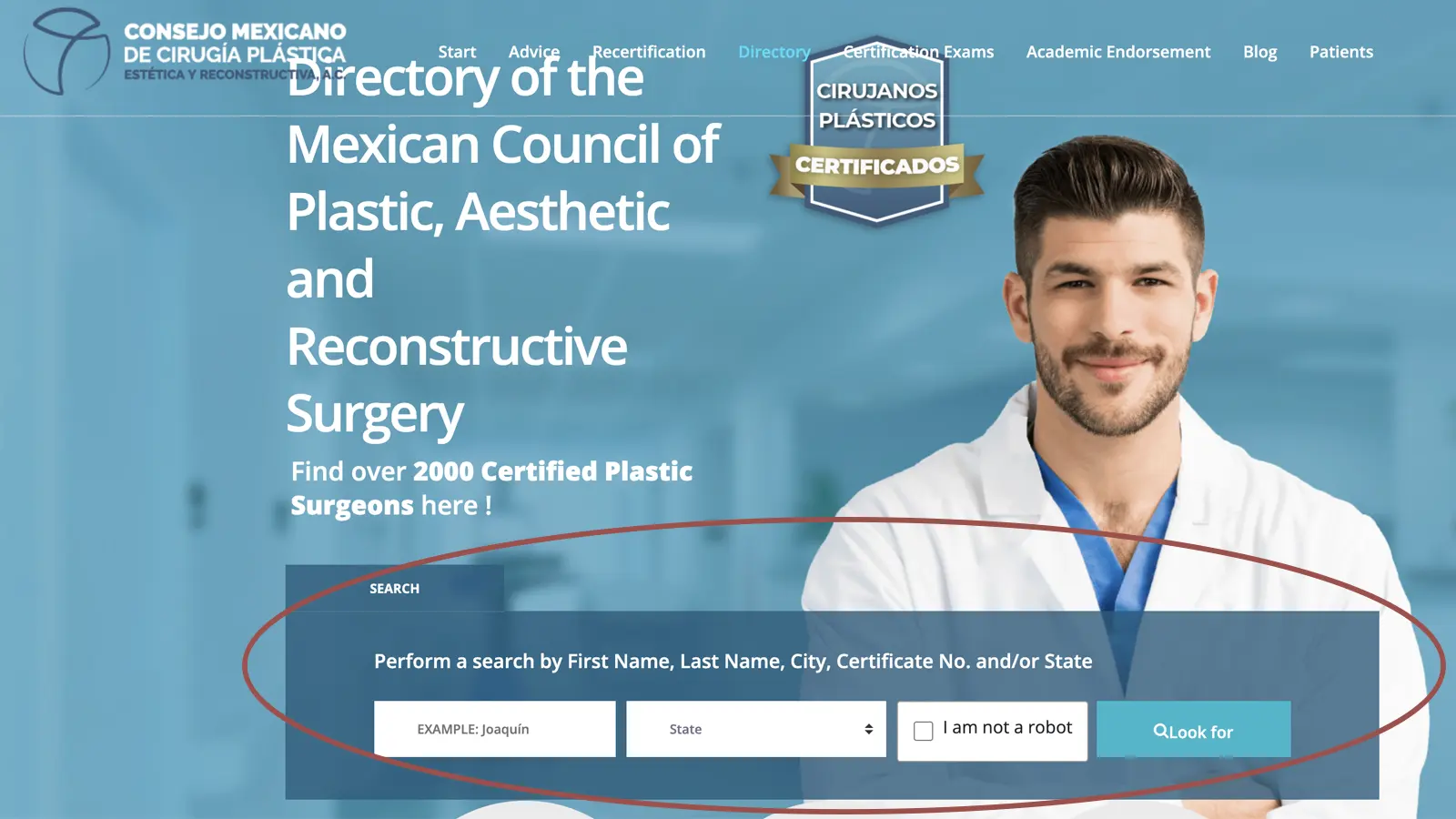
The Consejo Mexicano de Cirugía Plástica, Estética y Reconstructiva (CMCPER) is the organization recognized by CONACEM to certify specialists in plastic, aesthetic, and reconstructive surgery in Mexico. According to the CMCPER, surgeons complete their specialty training and certification process, and certification is subsequently renewed on a five-year cycle.
The CMCPER website allows patients to search for certified plastic surgeons, so I search the surgeon's name directly rather than relying on a badge, certificate, screenshot, or statement on a clinic's website.
If I can't find someone I expected to find, I don't automatically jump to conclusions, but I also don't ignore the discrepancy. I verify the spelling, ask the surgeon or clinic for their certificate number, and contact the appropriate organization directly if necessary.
For me, the important point is simple: I want to independently verify the surgeon's certification status through the organization responsible for that certification.
Step 3: Confirm Who Will Actually Perform Your Surgery
This step sounds obvious until you start researching large cosmetic surgery clinics.
The clinic's name and the surgeon's name aren't necessarily the same thing, and beautiful branding, a polished Instagram account, impressive before-and-after photos, or thousands of followers tell you very little about the credentials of the individual who will actually be standing over the operating table.
Before booking, I ask one very direct question:
What is the full legal name of the surgeon who will personally perform my procedure?
I don't want the coordinator's name, the clinic owner's name, or simply the name of the surgeon most prominently featured on the clinic's social media. I want to know exactly who is scheduled to perform my surgery, and then I independently research that person's credentials.
Once I have the name, I run it through the relevant credential searches myself. I also confirm again before surgery that the person I'm expecting to operate is still the person assigned to my case.
This is particularly important if you're traveling internationally for surgery because you don't want to arrive in another country and discover that your assumptions about who would perform your procedure were incorrect.
Step 4: Check Professional Association Membership
Once I've verified the primary credentials, I may also look at professional association membership as another piece of information.
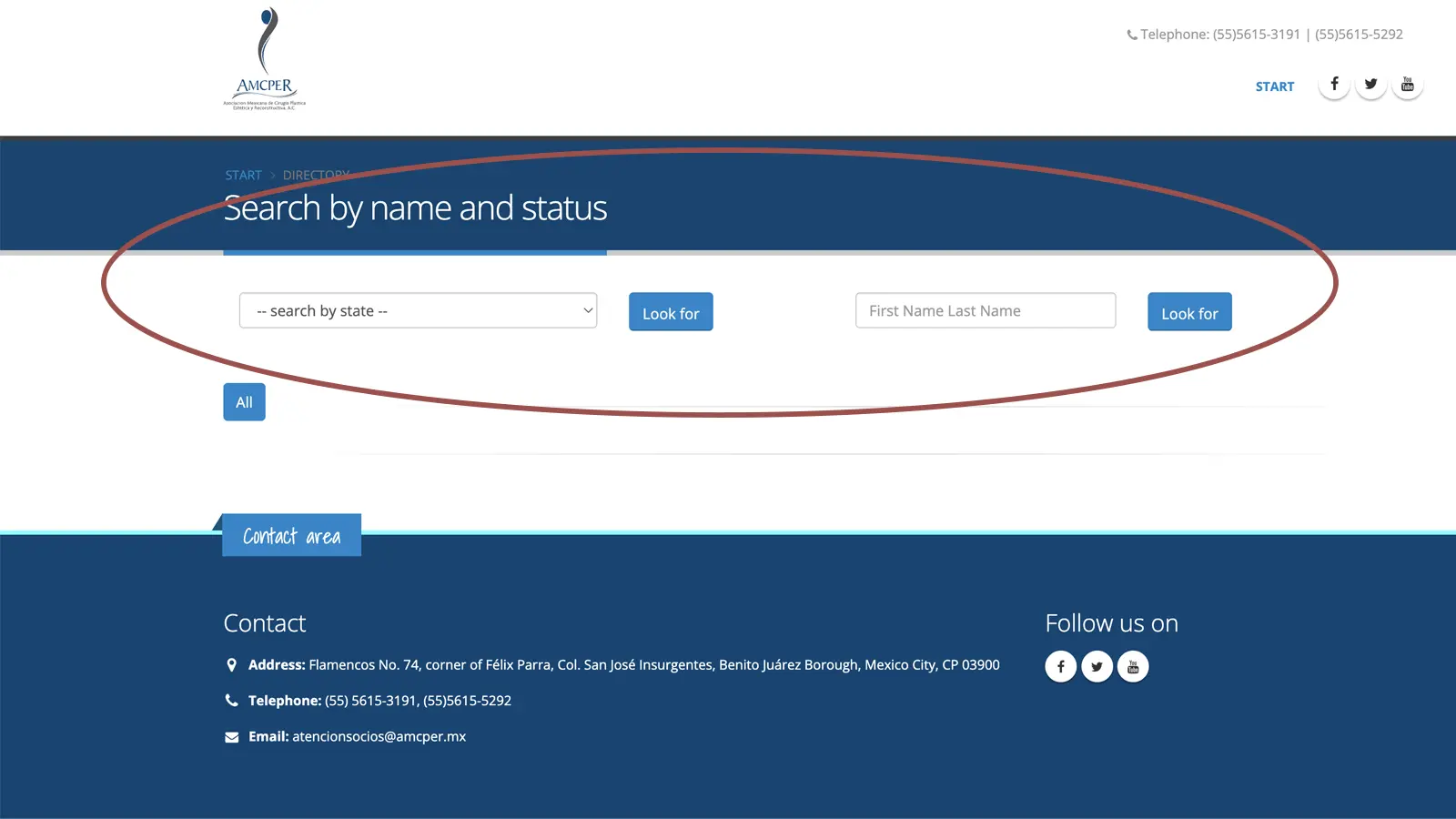
The Asociación Mexicana de Cirugía Plástica, Estética y Reconstructiva (AMCPER) maintains an online directory that can be searched by a surgeon's name and state.
I consider this an additional data point rather than a substitute for checking certification. Certification and professional association membership are different things, so I don't treat membership in an association as proof of certification by itself.
What I'm trying to build is a fuller picture of the surgeon: their credentials, specialty, professional involvement, experience, results, reputation, and communication with patients.
Red Flags I Watch for When Researching Plastic Surgery in Mexico
Credentials are only one part of my research process, and there are several things that would make me slow down and ask more questions.
- If a clinic won't clearly tell me the full legal name of the surgeon who will operate on me, that's a major concern because I can't independently verify someone whose identity I don't know.
- If I'm shown a professional cédula as proof that someone is a certified plastic surgeon, I still independently verify the surgeon's specialty certification through the appropriate certification body. Different credentials establish different things, and I don't want to assume they're interchangeable.
- If names, certification information, or other details don't match across official sources, I don't simply assume it's a clerical error. There may be a perfectly reasonable explanation, but I want that discrepancy resolved before sending money or scheduling surgery.
- I'm also cautious about aggressive sales tactics. If a surgeon or clinic starts using phrases like "book today," "book within 24 hours," or "the price goes up tomorrow," I take that as a reason to slow down rather than speed up. Major surgery should not feel like a flash sale.
How I Research a Plastic Surgeon Beyond Their Credentials
Passing the credential check doesn't automatically mean I'm ready to book. It means the surgeon has passed my first filter, and that's when I start looking more closely at patient experiences, surgical results, communication, and professional involvement.
1. Read Google Reviews, but Read Them Critically
Google reviews of the clinic or surgeon are an obvious place to start, but I don't simply look at the star rating.
I read both positive and negative reviews and look for recurring patterns. I also pay attention to whether the clinic responds to criticism and how it responds, because the way a practice handles an unhappy patient can sometimes tell you as much as a five-star review.
I'm also aware that online reviews aren't foolproof, so I don't let one platform make the decision for me.
2. Search Plastic Surgery Facebook Groups
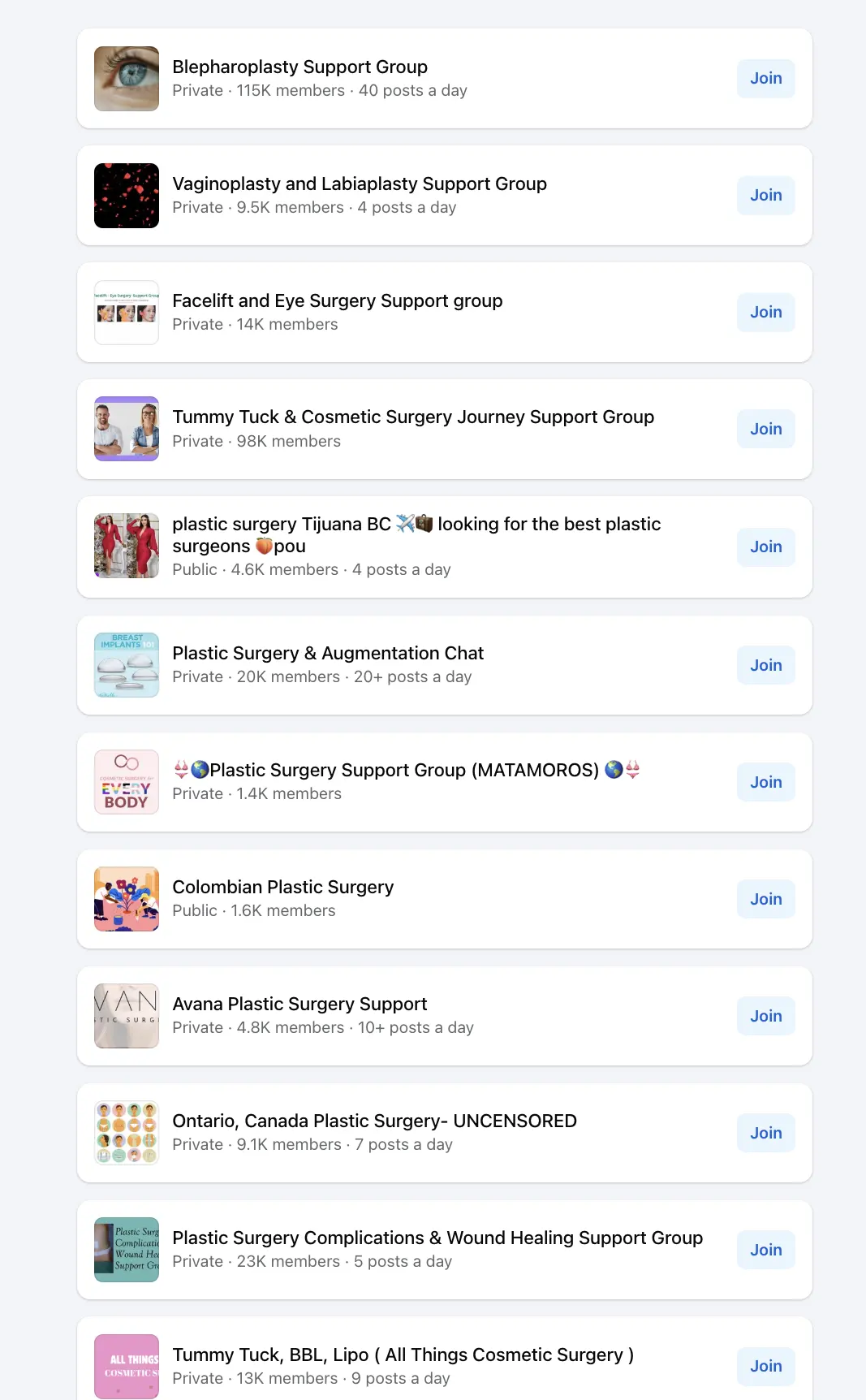
Plastic surgery Facebook groups can be incredibly useful because you can search the group's history for a specific doctor's name and find conversations that may never appear in Google search results.
I look for posts from people who have actually had surgery with that doctor, especially updates showing their recovery over time rather than only a single before-and-after photo.
I still approach these testimonials critically. If a glowing review comes from an account with almost no history, little interaction in the group, or posts that read more like promotional copy than a patient's personal experience, I take that into consideration.
No single Facebook post—positive or negative—would determine my decision, but patterns across many patient experiences can be useful.
3. Look at the Surgeon's Involvement in the Medical Community
This isn't something I consider mandatory, but personally, I feel more comfortable when I can see evidence that a surgeon remains engaged with their professional community.
I look at whether they attend or participate in plastic surgery conferences, continuing education, professional meetings, presentations, or other relevant medical activities. For me, it's another indication that someone remains engaged with developments in their specialty rather than treating their education as something that ended years ago.
Again, this doesn't replace credential verification, and attending conferences certainly doesn't prove that someone is a great surgeon. It's simply another piece of the overall picture I'm trying to build.
Credentials Are the Beginning, Not the End
Learning how to verify a plastic surgeon in Mexico is one of the most useful things you can do when researching cosmetic surgery abroad, but I don't think credentials should ever be the only deciding factor.
Certification tells me that someone has met particular professional standards. It doesn't tell me whether I like their aesthetic, whether they have extensive experience performing the exact procedure I want, how they respond when complications occur, what their aftercare looks like, whether their communication style works for me, or whether I'm personally a good candidate for the surgery.
That's where the consultation becomes incredibly important.
Once I've verified a surgeon's credentials, I start asking much more specific questions about their experience, complications, recovery, revisions, long-term results, and what I can realistically expect from the procedure.
If you're at that stage of your research, read my 10 Questions to Ask Before Cosmetic Surgery next. These are the questions I wish I'd known to ask before my own first cosmetic procedure, and they pair directly with the credential checks above.
Quick Checklist: How I Verify a Plastic Surgeon in Mexico
Before I consider booking cosmetic surgery in Mexico, I want to be able to check each of these off:
- Verify the doctor's professional credentials through Mexico's official system.
- Search for the surgeon through the CMCPER and verify their certification status.
- Confirm the full legal name of the surgeon who will actually perform the procedure.
- Make sure the credentials I researched belong to that exact surgeon.
- Check additional professional association membership when relevant.
- Research patient experiences across multiple sources rather than relying on testimonials from the clinic alone.
- Review longer-term before-and-after results for the specific procedure I'm considering.
- Ask questions about complications, aftercare, recovery, and revisions before paying a deposit.
Verifying credentials doesn't guarantee a perfect surgical outcome, nothing can, but it gives me a much better foundation for deciding who I'm willing to trust with my health and body.
This article shares my personal research process as a cosmetic surgery patient and medical tourism content creator and is intended for informational purposes only. It is not medical or legal advice, and credentialing requirements and online registries can change. Verify current information directly with the appropriate Mexican authorities and professional organizations, and discuss your individual procedure and risks with appropriately qualified healthcare professionals.