


.svg)
COSMETIC SURGERY
One Month After My Facelift: Honest Recovery Update
One month after my deep plane facelift, I'm sharing an honest look at my swelling, scars, results, and the emotional side of adjusting to my changing face.
One Month After My Facelift: My Honest Recovery, Results and Emotional Update
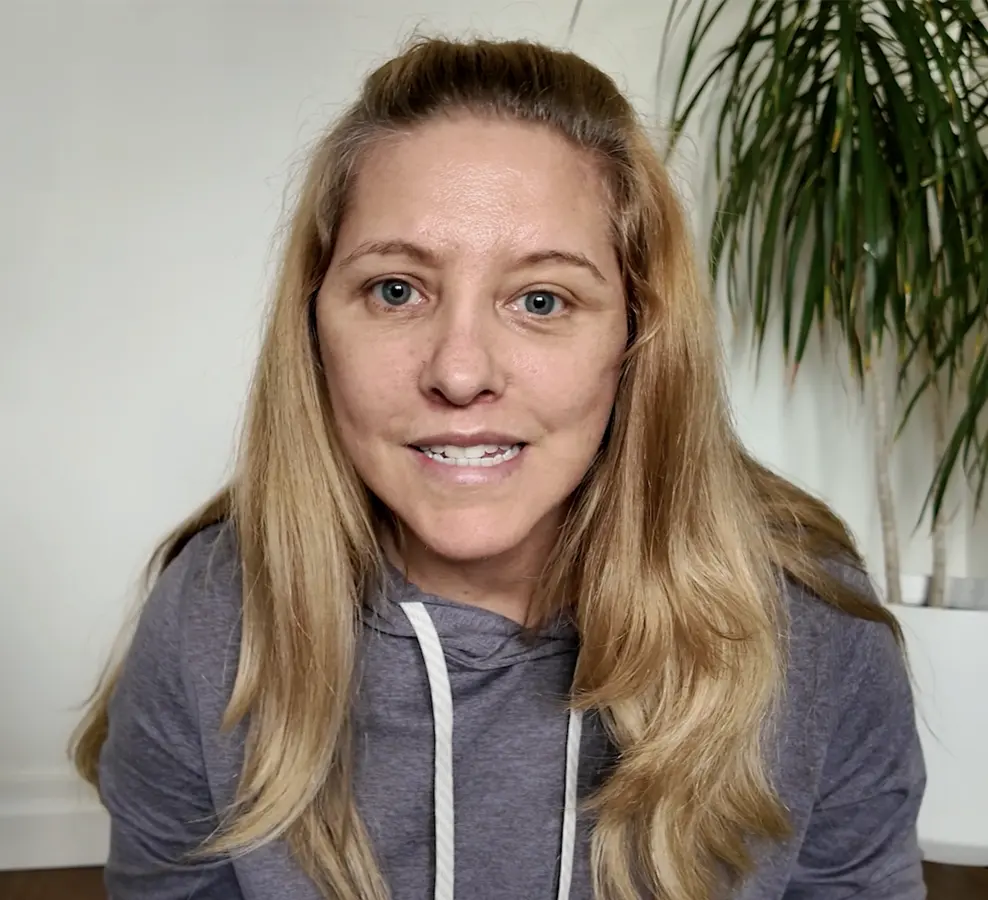
I'm officially one month post-facelift, and I want to show you what my face actually looks like at this stage, not just the physical changes, but the emotional side of recovery too, because honestly, that part has surprised me more than anything else.
Do I love how I look right now? No. Not yet.
I still catch myself noticing small new lines when I talk, wondering what happened to my face and occasionally asking myself whether having surgery was a mistake. My husband keeps telling me I look great and that nobody would even know I'd had anything done, although there are days when I don't fully believe him.
That's why I wanted to document this point in my facelift recovery timeline before I know how the story ends. This isn't the retrospective version where I'm six months post-op, everything has settled, and I can confidently tell you it was all worth it. I'm still swollen, I'm still healing, and I'm still figuring out how I feel about the face looking back at me.
If you've been following along since my [facelift surgery day] [LINK] and [two-week facelift recovery update] [LINK], this is where things stand at the one-month mark after my deep plane facelift, neck lift, lip lift, and lower blepharoplasty—procedure by procedure, scar by scar, followed by the part I think deserves a lot more attention: what cosmetic surgery recovery can feel like emotionally.
Prefer to watch? In this video, I show you exactly what my face looks like one month after my facelift, neck lift, lip lift, and lower blepharoplasty, and share the physical and emotional parts of recovery that I wasn't fully prepared for.
What My Facelift Looks Like After One Month
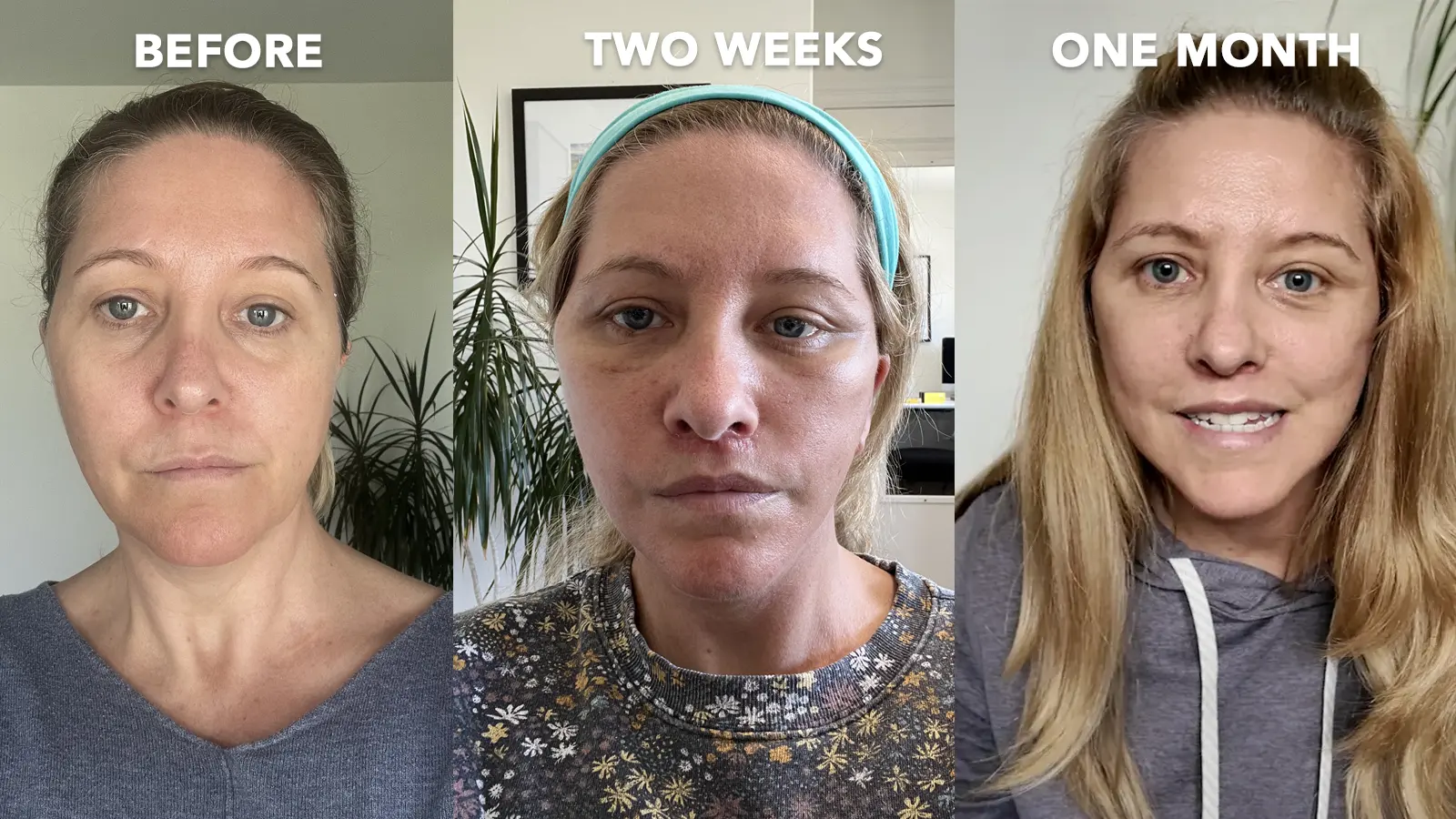
The biggest physical change between weeks two and four has been the swelling.
My face has come down substantially since the two-week mark, although I can still feel residual puffiness in several areas. There's still some pulling around one eye more than the other, along with a faint wrinkle that I'm watching to see how it changes as everything continues to settle.
I've also noticed that I currently have more movement on one side of my forehead than the other, while my neck and jawline remain somewhat bruised and tender.
When you're looking at your own face every day, it's surprisingly easy to obsess over tiny differences. I have to keep reminding myself that one month after a facelift is still part of the recovery process, not necessarily the point at which I'm supposed to judge my final result.
Sleeping After My Facelift and Neck Lift
I'm still sleeping on my back with my head elevated roughly 90 percent of the time because sleeping on my side becomes uncomfortable fairly quickly.
As someone who normally prefers sleeping on my side, this has been one of those seemingly small recovery details that becomes increasingly annoying the longer it goes on. I know it won't be forever, but a month of consciously thinking about your sleeping position makes you appreciate the day when you can simply roll over without thinking about your face.
During the first two weeks, I also had professional lymphatic drainage massages as part of my recovery. After that, I continued some gentle massage at home before eventually stopping when my neck became more tender and bruised than I was comfortable with.
This is one area where I'd recommend following your own surgeon's post-operative instructions rather than copying someone else's massage routine. Procedures and surgical techniques differ, and what one surgeon recommends during facelift recovery may not be appropriate for another patient.
Exercise, Protein and Getting Back to Normal
The hardest lifestyle adjustment for me has probably been exercise. Before surgery, I was arguably in the best shape of my life. I was regularly weightlifting and eating a high-protein diet of around 150 grams per day, so suddenly stepping away from that routine has been genuinely difficult.
I'm currently aiming for closer to 80 to 100 grams of protein a day, including a daily smoothie with added collagen, and I'm drinking plenty of water throughout the day. My normal skincare routine has also gradually returned, although I've been careful around the healing areas and continue to follow my surgeon's instructions regarding the incisions and scars.
For exercise, I've been doing 45- to 60-minute walks and tracking my activity with my Whoop band, but I haven't returned to weightlifting yet.
Part of that is physical recovery.
Part of it, if I'm being completely honest, is that I'm still uncomfortable with people seeing me.
I've remained mostly off-camera at work and haven't spent much time in public spaces. I know that's a version of hiding, and I'm aware of it even while I'm still doing it.
That realization has probably been one of the first indications that facelift recovery isn't only physical.
What My Facelift Scars Look Like at One Month
During the first couple of weeks, swelling and scabbing made it difficult for me to properly evaluate my scars. At one month, I can finally see much more of what's actually going on.
Around my ears, the incisions still feel slightly bumpy and rough in places, while the scars extending into my hairline are thankfully much less noticeable.
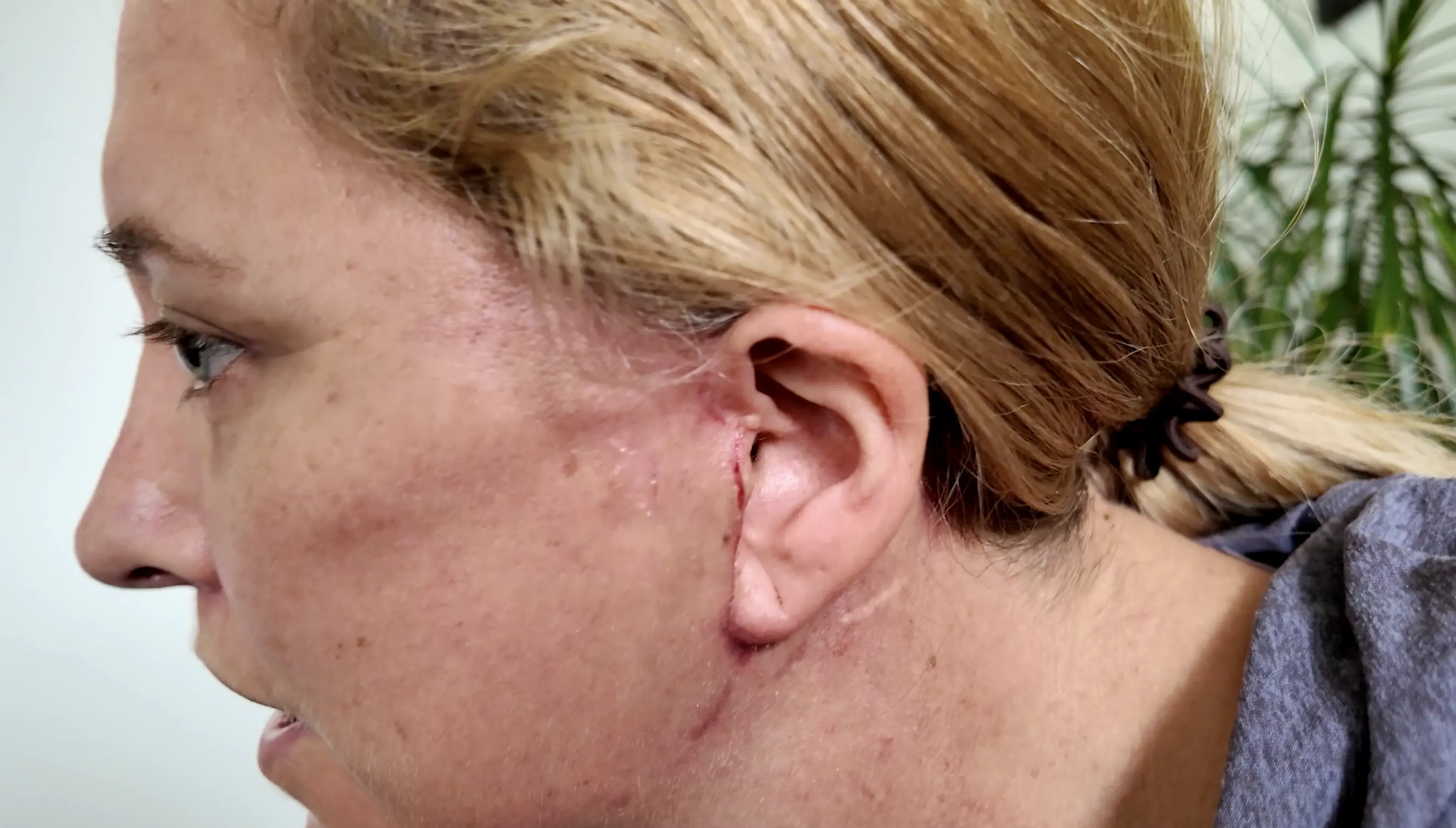
I know scars continue changing as they mature, so I'm trying not to decide what I think of them yet. That's easier said than done when they're on your own face.
My Lower Blepharoplasty Results at One Month
The area underneath my eyes still feels somewhat raised, although there was a specific reason for the approach my surgeon used.
Rather than simply removing the under-eye fat, my surgeon repositioned tissue to preserve volume in the area. Volume loss underneath the eyes can become more noticeable with age, and I'd already tried a fat transfer there in December 2024. In my case, I wasn't satisfied with the longevity of that result, and the under-eye bags eventually became noticeable again.
At this point, I think preserving that volume was the right decision for me, even though the area still looks unfamiliar while everything heals.
I also continue to have darkness underneath my eyes, which surgery wasn't intended to address. For me, that appears to be more related to genetics, skin thickness, and the underlying anatomy than simply the presence of under-eye bags.
My Lip Lift Recovery at One Month
Of everything I had done, the lip lift is still the procedure I feel most conflicted about.
I still have some dissolvable sutures near my nose, and the area underneath my nose remains tight, although I have considerably more movement and flexibility than I did immediately after surgery.
My smile has improved significantly. My upper lip no longer disappears completely when I smile, which was one of the reasons I wanted the procedure in the first place.
At the same time, my mouth still feels small to me in proportion to my nose, and I'm still adjusting to seeing the change.
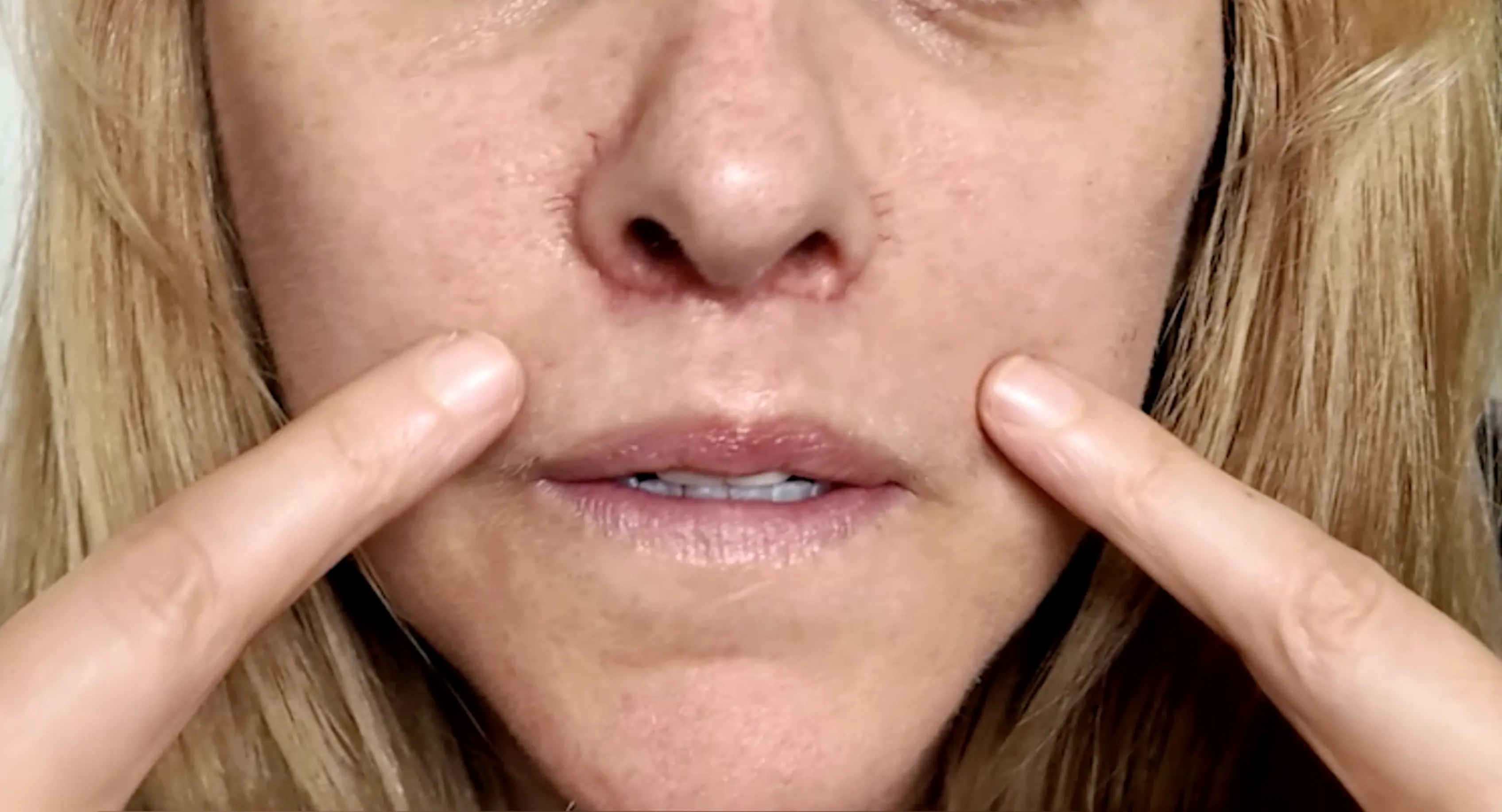
I had a CO2 laser treatment on my lip lift scar 13 days after surgery, and at the one-month mark the scar still looks dark and somewhat red when I'm not wearing makeup. I'm using the scar product recommended by my surgeon and being careful about sun protection while the area continues to heal.
My philtrum also doesn't look as straight as I'd hoped it eventually would. This was something my surgeon and I had discussed before surgery, and right now I genuinely don't know whether it will continue to change as the swelling and tightness resolve or whether it's something I'll eventually want evaluated again.
I'm deliberately trying not to make that decision at one month.
The Hardest Part of My Facelift Recovery Hasn't Been Physical
This is the part I think matters more than any individual scar, swollen area, or asymmetry I've described.
I'm struggling with the emotional side of facelift recovery more than I expected to.
There are days when I look in the mirror and wonder whether I look strange, whether something went wrong, and whether I'm going to feel this disconnected from my face indefinitely.
Then I go online.
I see other people's facelift before-and-afters where they look flawless, healed, confident, and thrilled with their decision, and it's genuinely difficult not to compare myself with them even though I know intellectually that I'm comparing my unfinished recovery with somebody else's carefully selected result.
That's one of the strange things about documenting cosmetic surgery on social media.
We see before and after constantly.
We don't see nearly enough during.
The swollen weeks. The asymmetry. The scars. The weird smile. The morning when something looks better followed by the afternoon when you're convinced it looks worse again.
Most importantly, we don't see enough of the period when someone genuinely doesn't know whether they're happy they did it.
That's where I am right now.
Is It Normal to Regret a Facelift During Recovery?
I've wondered this myself over the past month.
I don't know whether I'd describe what I'm feeling as regret, because that sounds much more definitive than where I actually am. It's closer to uncertainty.
I made a permanent change to a face I'd spent my entire life recognizing, and suddenly I'm analyzing details I'd barely thought about before. When you're still swollen and healing, it can be difficult to separate “this isn't my final result” from “what if I don't like my final result?”
Those are two completely different thoughts, but emotionally they can feel remarkably similar.
I've thought hard about whether I should even share this part. Posting photos of scars and talking publicly about uncertainty inevitably invites strangers to tell you what they think about your face, and I'm not convinced that's particularly helpful during recovery.
I keep coming back to something from Byron Katie's work that has stuck with me for years: what other people think of me is none of my business.
I'm not sharing this because I need strangers to tell me I look fine, and I'm not sharing it because I want strangers to tell me what they think went wrong.
I'm sharing it because this is genuinely what cosmetic surgery recovery looks like for me at one month, uncertainty included, and I think that's far more useful to someone considering a facelift than pretending I woke up four weeks later completely healed and unquestionably thrilled.
Cosmetic Surgery and the Temptation to Keep Fixing Things
This experience has also made me understand something I don't think I fully appreciated before surgery.
I can see how easy it would be to start chasing corrections.
You notice one thing that feels slightly off, so you think about fixing it. Then you notice something else. You start looking at your face differently, comparing it with old photographs, examining angles you never paid attention to before, and scrolling through other people's results.
Suddenly there's always one more thing that could theoretically be adjusted.
I understand much more clearly how someone can move from wanting to look refreshed to continually changing their appearance in pursuit of a feeling that another procedure may never actually provide.
I don't want that for myself.
My goal was never to look like a different person. I wanted to look like a rested version of myself.
Keeping sight of that feels particularly important right now, because knowing when not to change something may ultimately matter just as much as choosing what to change in the first place.
Was My Facelift Worth It at One Month?
If you're looking for me to say yes or no, I can't give you that answer yet.
That's actually the point of documenting this now.
Physically, I'm making progress. The swelling has decreased significantly, my movement is improving, my smile is becoming more natural, the incisions are healing, and every week looks different from the one before it.
Emotionally, I'm still adjusting.
I don't want to force myself to love the result simply because I chose to have surgery, just as I don't want to decide I regret it while I'm still very much in the healing process.
So at one month, my answer is simply:
I don't know yet. Ask me again at three months, then six months, or maybe a year.
I think documenting those changing answers will ultimately tell a much more useful story than pretending cosmetic surgery has a neat before-and-after ending.
My One-Month Facelift Recovery: Where Things Stand
At the one-month mark after my deep plane facelift, neck lift, lip lift, and lower blepharoplasty, I'm still somewhere in the middle.
My face is less swollen, my scars are becoming easier to evaluate, my movement is improving, and I'm slowly returning to normal life. There are things I already appreciate about the changes and others I'm still questioning.
The physical healing is progressing according to the guidance I've received from my surgeon, while the emotional side is very much still in motion.
I'm trying to let both things be true at the same time.
This isn't the polished "after."
It's the honest middle, and after going through it myself, I think the middle of cosmetic surgery recovery deserves to be documented just as much as the transformation at the end.
Frequently Asked Questions About My One-Month Facelift Recovery
What procedures did I have?
I had a deep plane facelift, neck lift, lip lift, and lower blepharoplasty during the same surgical period. This article documents my personal recovery at approximately one month after surgery.
Is my face still swollen one month after my facelift?
Yes. My swelling has decreased considerably since the first two weeks, but I can still see and feel residual swelling in several areas. My surgeon is monitoring my individual recovery, and I'm not treating my one-month appearance as my final result.
Can I see my facelift scars after one month?
Yes. My incisions around the ears are still visible and feel somewhat bumpy in places, while the portions extending into my hairline are considerably less noticeable. I'm continuing to follow my surgeon's scar-care recommendations.
Am I exercising one month after my facelift?
I'm walking approximately 45 to 60 minutes daily, but I haven't returned to my normal weightlifting routine yet. When someone can safely return to exercise after surgery depends on their procedure and individual recovery, so this is something to discuss with your own surgeon rather than following my timeline.
Do I regret getting a facelift?
At one month, I wouldn't call what I'm feeling regret. I'd call it uncertainty. I'm still adjusting to changes in my face while simultaneously healing from several procedures, so I'm deliberately giving myself more time before deciding how I feel about the final result.
This article documents my personal experience with cosmetic surgery and is provided for informational purposes only. It is not medical advice. Always discuss the risks, benefits, recovery expectations, travel considerations, and suitability of any procedure with appropriately qualified healthcare professionals.