

.svg)
COSMETIC SURGERY
What to Expect on Facelift Surgery Day: A Firsthand Experience
A firsthand look at what really happens on facelift surgery day, from pre-op preparation to the unexpected realities of the first 24 hours of recovery.
If you're considering a deep plane facelift and wondering what actually happens on facelift surgery day, I want to take you through my experience from the moment I arrived at the surgical center and started getting prepped to the much more intense reality of waking up after surgery and realizing my first 24 hours of recovery weren't going to look anything like I had imagined.
At 47, I traveled from Canada to Los Angeles for a deep plane facelift, neck lift, lip lift, and lower blepharoplasty, and despite what people might assume when they hear "Los Angeles" and "plastic surgery" in the same sentence, I wasn't chasing a celebrity surgeon or some exclusive Beverly Hills experience. One of the biggest reasons I traveled was much more practical: the difference in cost was significant.
This story isn't really about why I decided to have surgery in the first place, because that's something I've talked about separately and deserves a conversation of its own. What I want to share here is something I had a surprisingly hard time finding before my surgery: a detailed, firsthand account of what facelift surgery day actually feels like when you're the person walking into the surgical center.
I wasn't looking for another medical explanation of how a facelift works or another perfectly curated set of before-and-after photos. I wanted to know what would happen when I arrived, how I would be prepared for surgery, what it would feel like when I woke up, whether I would be able to eat or drink, how I would communicate, and what would happen if my recovery didn't go according to the plan.
My Facelift Surgery at a Glance
I was 47 years old when I traveled to Los Angeles, California, to have a deep plane facelift, neck lift, lip lift, and lower blepharoplasty performed by Dr. Batal, a surgeon I had previously worked with for a brow lift and lipo 360. I paid $20,000 USD for this combination of procedures, I expected to leave the surgical center the same day, and I ultimately stayed until the following evening because my immediate recovery was more difficult than anticipated.
The biggest surprise wasn't the surgery itself; it was waking up so swollen around my eyes and throat that I couldn't open my eyes or speak normally, which completely changed what those first hours of recovery looked like. My experience is exactly that—my experience—and it shouldn't be interpreted as medical advice or as a prediction of how another person's facelift surgery or recovery will unfold, since procedures, anesthesia, complications, recovery timelines, pricing, and results can vary considerably from one person to another.
Why I Decided to Get a Deep Plane Facelift at 47
My relationship with my face has always been complicated, mostly love if I'm being fair, although there has also been a long-running subplot of self-esteem struggles that I could probably turn into an entire memoir. I was born with torticollis, and I carry birth defects and trauma from a car accident that happened while I was still in the womb, so my relationship with my appearance has never been particularly simple.
I've shared more of that story elsewhere because it deserves more space than a surgery-day recap can give it, although by my mid-40s something different was beginning to bother me. The signs of aging seemed to arrive almost overnight, and suddenly I was noticing sagging around my jowls, a jawline that wasn't as defined as it used to be, hollowness and bags underneath my eyes, and lines around my mouth that seemed to be getting deeper by the day.
I wasn't trying to turn myself into somebody else or erase every sign that I'd lived for 47 years. I wanted to look like myself, only more rested and slightly younger, with a more defined jawline, less sagging around my jowls, softer lines around my mouth, a shorter distance between my nose and upper lip, and less hollowness and baggage underneath my eyes.
I was really happy with the results I got from Dr. Batal with a previous surgery, which meant I wasn't walking into this experience with a surgeon I'd never met. Having already been through surgery with him gave me a level of comfort and confidence that mattered when I was considering a much larger combination of procedures, especially because he performs a significant number of facelifts.
Setting Realistic Expectations Before My Facelift
One of the conversations I think matters enormously before cosmetic surgery is the one about expectations, because it's incredibly easy to walk into a consultation carrying an image of somebody else's face in your head. It might be a celebrity's nose, somebody's jawline you saw on Instagram, or even an AI-generated image showing an idealized version of your own features, yet none of those things necessarily represent what is realistic or appropriate for your individual anatomy.
My goal was never to walk out of surgery looking like a different person; I wanted to recognize myself when everything healed, only hopefully looking a little more refreshed and youthful. Having that conversation with my surgeon beforehand helped establish what I wanted from the procedure while also reminding me that cosmetic surgery isn't about ordering someone else's features from a menu.
Your anatomy, goals, procedures, health considerations, and expectations are individual, which is why those conversations belong between you and a qualified surgeon rather than being based entirely on somebody else's results, including mine.
Why I Traveled From Canada to Los Angeles for My Facelift
The cost difference between the quotes I received in Canada and what I ultimately paid in Los Angeles was substantial, with Canadian quotes ranging from approximately $50,000 to $80,000 CAD for the combination of procedures I wanted compared with the $20,000 USD I paid Dr. Batal. That gap was large enough to make traveling for surgery a serious consideration rather than simply an interesting alternative.
Traveling for healthcare also wasn't an entirely foreign concept to me, because a few years earlier I had fallen down some stairs and developed a baseball-sized seroma on my hip, essentially a pocket of fluid that wasn't improving despite the chiropractic and osteopathic treatments I tried. I couldn't find a surgeon in Canada willing to treat it because it wasn't a typical case, and I eventually found someone who could help me through, of all places, TikTok.
That experience changed the way I thought about accessing healthcare, because sometimes people travel to find a particular specialist, sometimes they're dealing with long waits or limited options, and sometimes the difference in price becomes too significant to ignore. My own experiences have exposed me to several of those realities, which is also part of why I've become so interested in exploring what healthcare, wellness, aesthetics, and medical tourism look like outside the system closest to home.
What Happened Before My Facelift Surgery
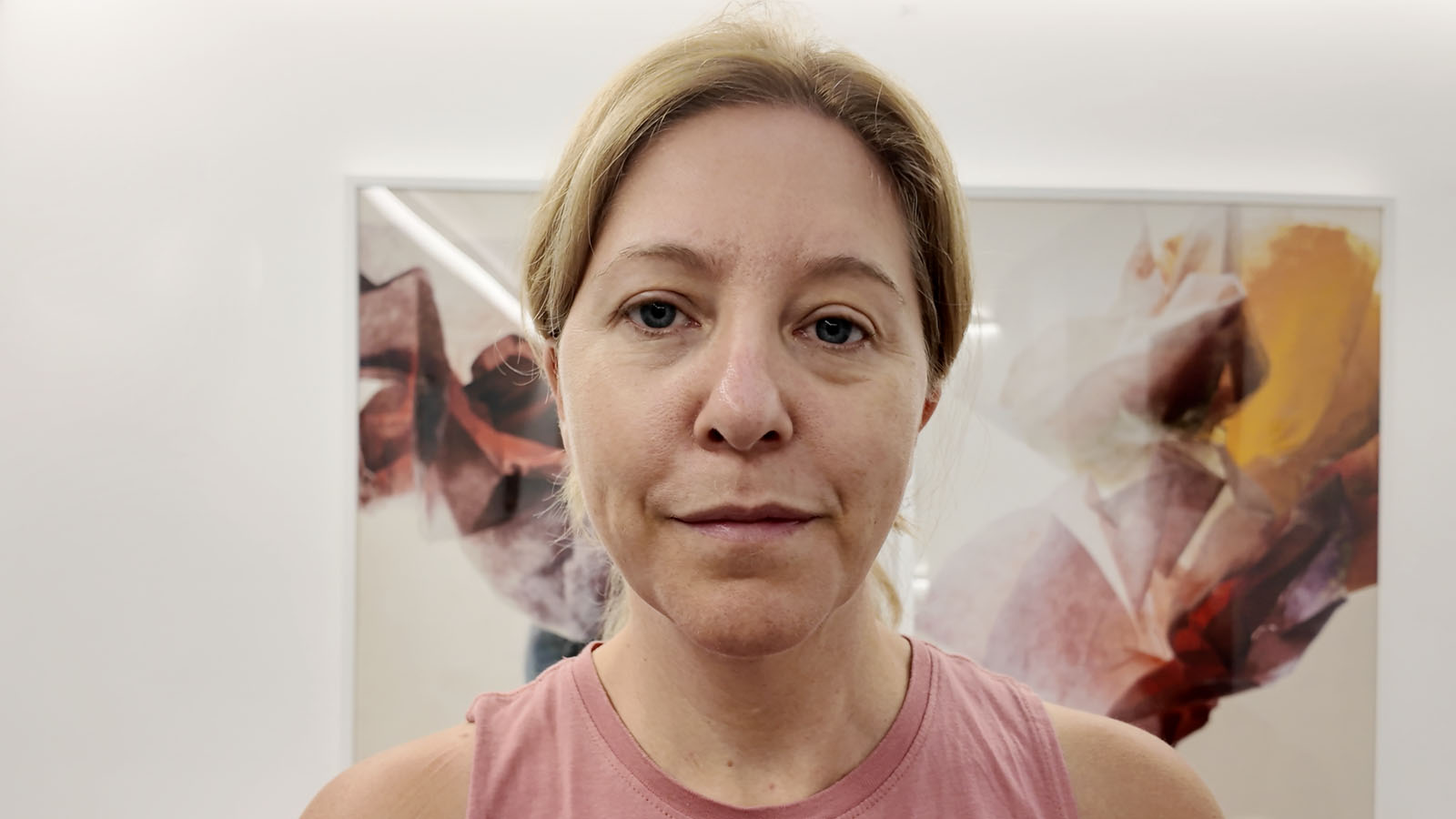
Surgery morning was much quieter than I had imagined, with the surgical center carrying that strange pre-surgery calm where nurses are moving around getting everything ready while you're sitting there knowing something enormous is about to happen. There was paperwork to complete, consent forms to sign, and a surprising amount of waiting while I tried to give myself a mental hype talk about what I was about to do.
When you strip away all of the polished language surrounding cosmetic procedures, I was preparing to let someone surgically alter my face, which is a fairly surreal thing to contemplate while you're sitting there waiting for the calming medication to kick in. I remember trying to convince myself that everything was fine while simultaneously being very aware of the magnitude of the decision I'd made.
Getting My IVs Was an Adventure
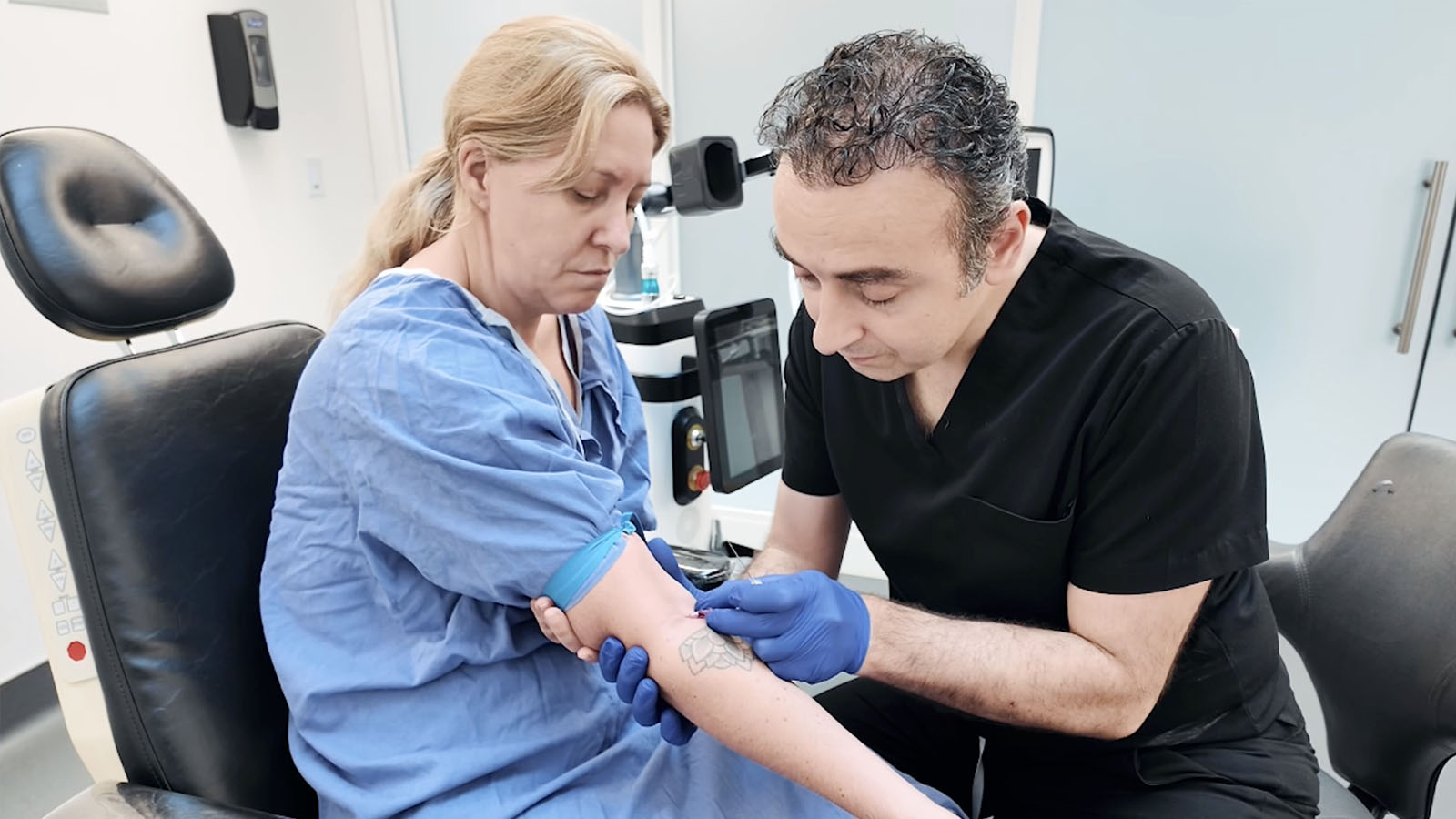
The next part involved inserting my IVs, and my doctor placed two of them, one in each arm, so there would be a backup if one line failed during the procedure. My veins aren't particularly cooperative at the best of times, which already makes this part interesting, although my bigger problem is that I absolutely cannot stop myself from watching needles go in.
I have a kinesiology degree and I'm fascinated by the human body, so my brain insists that I need to watch whenever someone inserts a needle, even though my nervous system has repeatedly demonstrated that it does not share this fascination. Watching the needle triggered a vasovagal response, my blood pressure and heart rate dropped enough that I needed to lie down, and once again I was reminded that the thing I find scientifically fascinating is also the thing most likely to make me faint.
The ridiculous part is that I know this about myself, I know watching can trigger the reaction, and I still watch every single time.
Before Photos and Surgical Markings
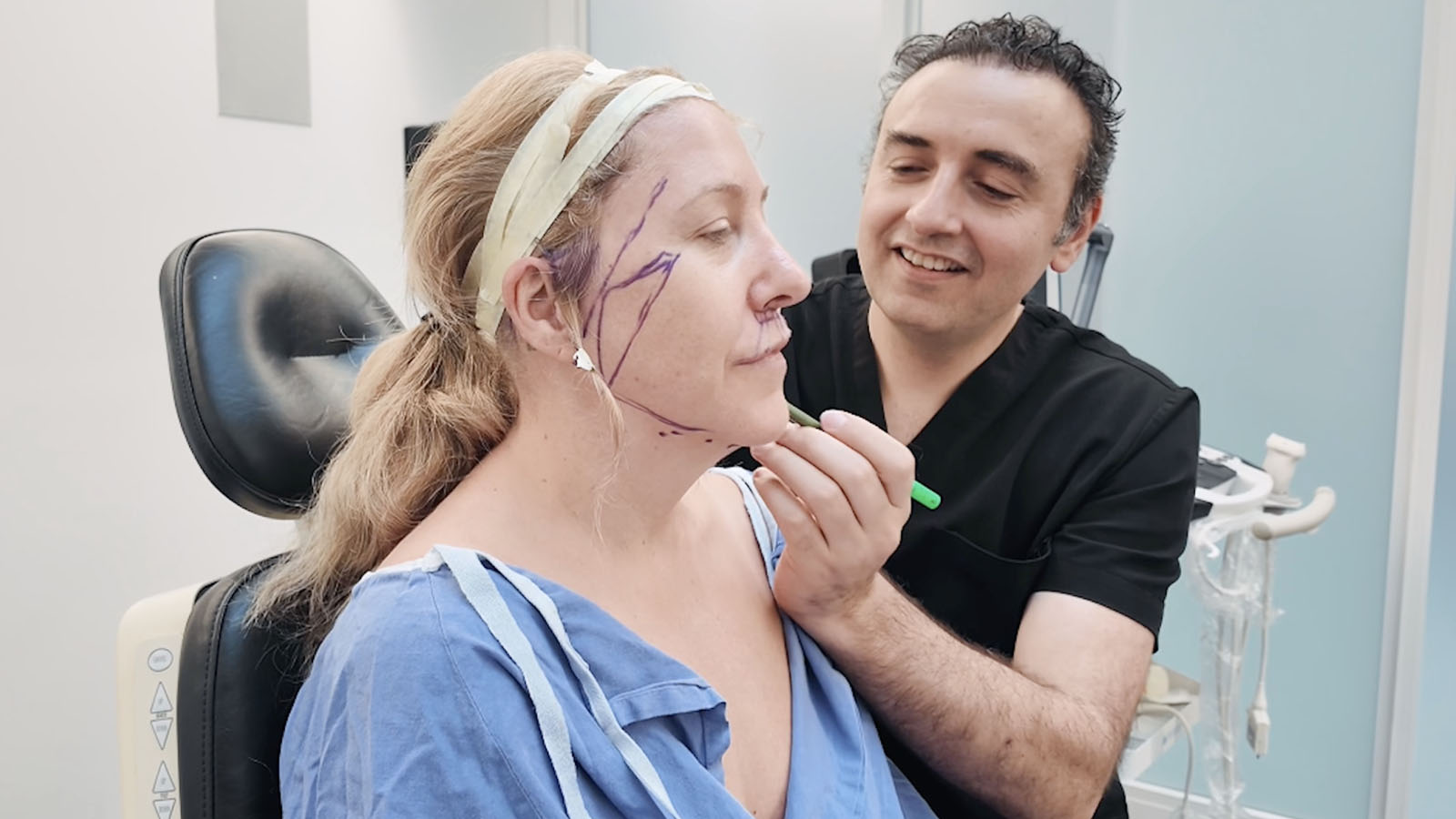
Once I recovered and felt steady enough to stand again, we moved into a photo studio area where my official before photos were taken from what felt like every possible angle. Those photographs would document my starting point, which meant there was no strategic lighting, flattering pose, or favorite side of my face to hide behind.
The surgical markings came next, with my surgeon drawing the planned incision lines directly onto my face and mapping out where the scars would eventually be positioned along areas such as my hairline and behind my ears. Watching someone draw the roadmap for your surgery onto your own reflection is a genuinely strange experience, because this is the moment when everything you've discussed in consultations suddenly becomes very real.
The entire pre-operative process took around 90 minutes, after which there was nothing left to discuss, photograph, sign, or prepare. It was time to walk into the operating room.
The Procedures I Had During My Facelift Surgery
My surgery involved four procedures rather than a facelift alone: a deep plane facelift, neck lift, lip lift, and lower blepharoplasty, with each procedure addressing a different concern that had been part of my overall goals. The facelift and neck lift were intended to address the sagging and definition around my lower face and neck, the lip lift was intended to shorten the distance between my nose and upper lip, and the lower blepharoplasty addressed the under-eye area that had been bothering me.
Because I was under anesthesia, I obviously can't give you a firsthand play-by-play of what happened inside the operating room, which is why I'm not going to pretend that I can. What I can describe in great detail is what happened when I woke up, because that's where my experience became very different from the version I had pictured in my head.
What Happened When I Woke Up After My Facelift
The surgery itself was a success, and I woke up in recovery with the assumption that the hardest part was probably behind me. I had expected to recover for a while and then leave the surgical center that same day, returning to the Airbnb where I would begin the next stage of healing.
My body had a completely different plan.
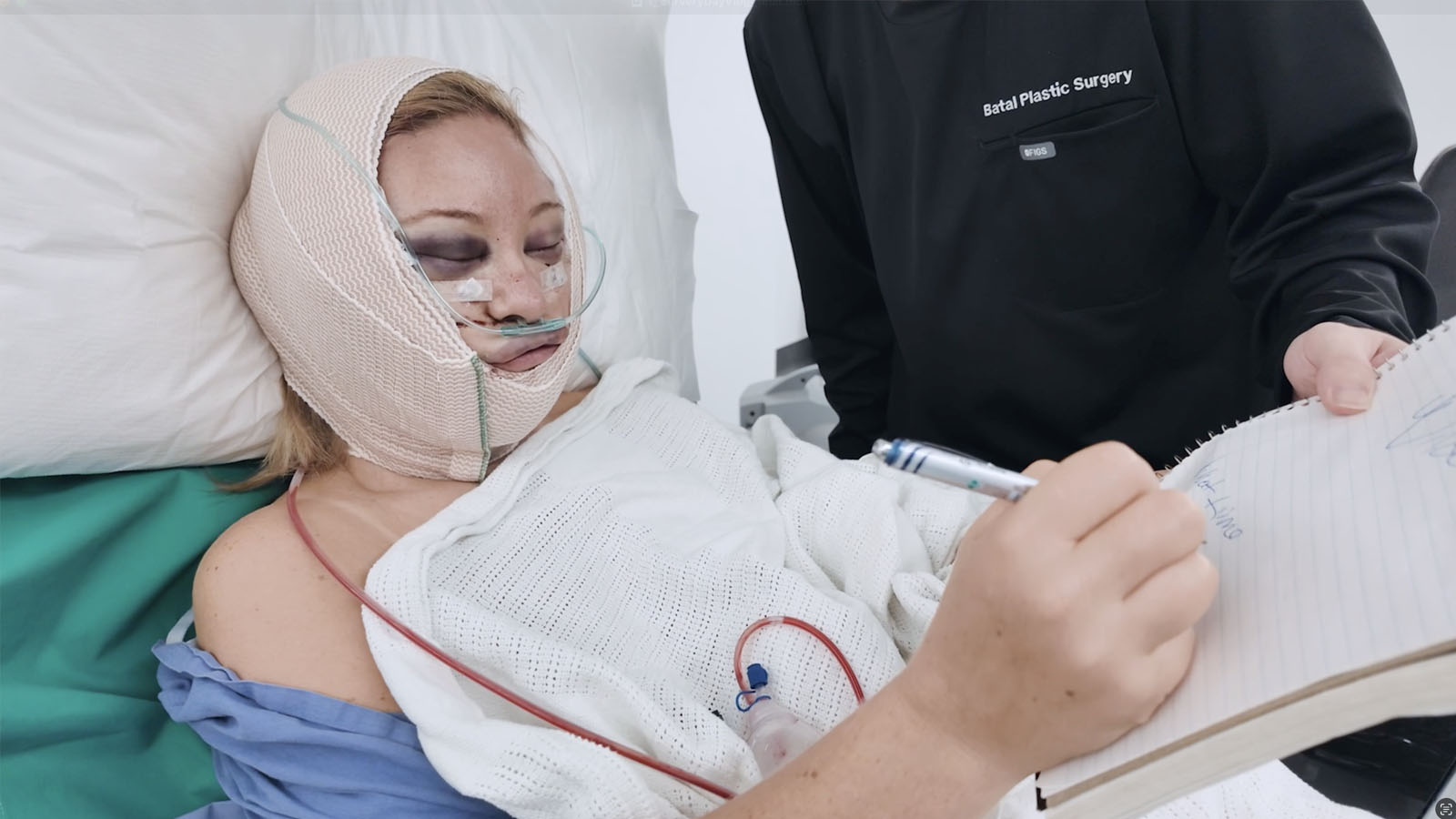
The swelling around my eyes and throat was significant enough that I couldn't open my eyes or speak, and when that was combined with concerns around how I was breathing, it became clear that I wasn't going anywhere. The surgical team wanted to keep me on oxygen and continue monitoring me, so instead of leaving for the Airbnb as planned, I stayed overnight at the surgical center.
In my particular situation, I was incredibly grateful that the team made the decision to keep me there rather than sending me back to the Airbnb simply because same-day discharge had been the original plan. That experience also taught me something I hadn't spent enough time thinking about before surgery: you can plan your recovery down to the smallest detail, yet your body ultimately gets a vote.
The Hardest Part of My First Night After Facelift Surgery
For a long stretch after waking up, I couldn't open my eyes or speak, yet I could hear absolutely everything happening around me, which created one of the strangest and most disorienting experiences of the entire process. I was fully aware of my surroundings and knew people were nearby, although I had almost no ability to communicate with them in the way I normally would.
I leaned heavily on breathing exercises and quiet affirmations to keep myself calm, while my husband eventually brought me a notepad so I could try to communicate in writing. I could see through the tiniest blurry slit in one eye, so I desperately attempted to write down words while barely being able to see what I was putting on the page, and for a while my most reliable form of communication became a simple thumbs up or thumbs down.
That experience unexpectedly made me think about people who live permanently with limitations around vision or communication, because the temporary loss of those abilities was incredibly disorienting even when I knew mine would return. I had gone into surgery thinking about my face, my results, and my recovery, yet I found myself lying there thinking about something much larger than any of those things.
My First 24 Hours of Facelift Recovery
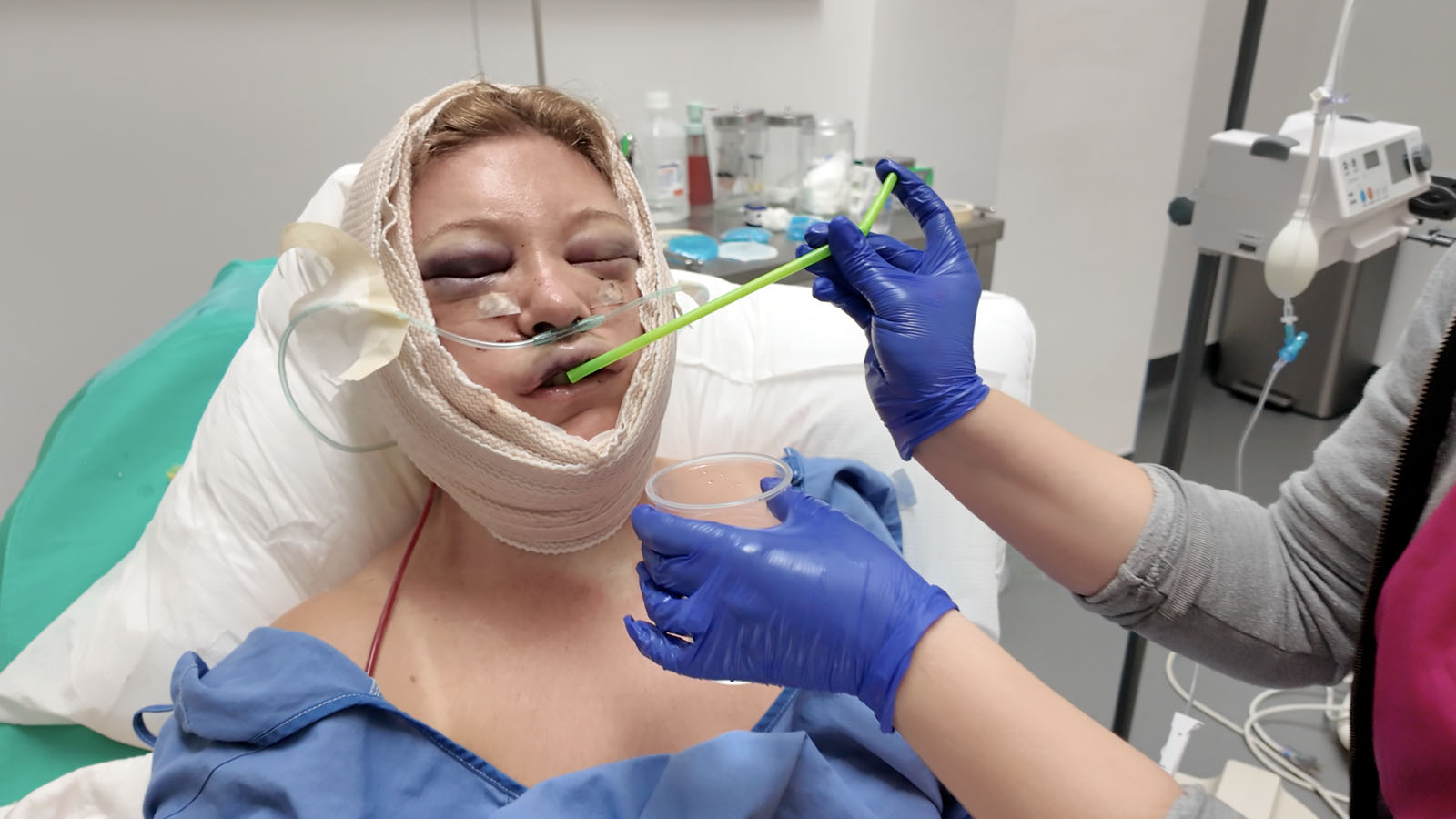
The following morning, at around 8 a.m., I had my first lymphatic drainage massage to help with the swelling, which was uncomfortable because everything was understandably sore and tender. The thing I remember even more vividly than the massage, however, was how desperately I wanted water.
My throat was too tight for me to manage a straw and my lips were too swollen to sip normally, so I was given water in tiny droplets, which sounds almost insignificant until you're unbelievably thirsty and those tiny droplets are the only water you can manage. I don't think I've ever been that thirsty or that grateful for water in my entire life, and those little drops genuinely felt like bliss.
Food was strangely different because I didn't feel hungry at all, with no real appetite or desire to eat for most of the day. By approximately 8 p.m. that evening, I finally felt strong enough and was cleared to leave the surgical center, and I don't think I've ever been happier to see an ordinary bed and all the normal comforts of a place that wasn't a medical facility.
Once we arrived at the Airbnb, I tried to eat some soup, which turned into its own project because my mouth could still barely open. These were the details I hadn't really thought about beforehand, because I'd spent so much time considering the facelift itself that I hadn't spent nearly as much time imagining what it might be like to drink water, eat, communicate, or simply function during those first hours afterward.
How Much My Deep Plane Facelift Cost
Cost is one of the first things people ask me about, and I understand why, especially when the price of cosmetic surgery can vary so dramatically depending on where you live and where you're willing to travel. For my combination of procedures, the quotes I received in Canada ranged from approximately $50,000 to $80,000 CAD, while I paid $20,000 USD to Dr. Batal in Los Angeles.
That number needs context, because what I paid isn't necessarily what another patient would be quoted even if they went to the exact same surgeon for what appeared to be the exact same combination of procedures. Every patient has different anatomy and needs, pricing can vary based on the procedures involved, surgeon, facility, and other factors, and my own price was also affected by the fact that I was a repeat patient.
I think of the amount I paid as a data point rather than a benchmark, which is an important distinction when you're researching the cost of cosmetic surgery online. Someone else's price can help you understand the general landscape, although it should never replace getting your own consultation, asking your own questions, and receiving a quote based on your individual circumstances.
The Costs of Traveling for Facelift Surgery That Aren't in the Quote
The surgeon's quote is only part of what traveling for cosmetic surgery can cost, because there are also flights, accommodation, recovery supplies, medications, transportation, support, and the possibility that your original recovery plan may change. In my case, I also had to consider an unexpected overnight stay and the logistics of recovering in an Airbnb rather than in my own home surrounded by my normal routines.
Some of the harder costs to calculate aren't financial at all, because you also have to think about how comfortable you are recovering away from home, who will be there to help you, and what will happen if your recovery doesn't unfold according to the ideal timeline. Those questions became much more important to me after experiencing a first night that looked nothing like the version I had expected.
What I Wish I'd Known Before Facelift Surgery Day
If I could go back and prepare myself for surgery day again, I would spend less time worrying about what was going to happen in the operating room and more time asking about what could happen immediately afterward. I had focused so much attention on the surgery itself and the eventual outcome that I hadn't given nearly enough consideration to what those first vulnerable hours of recovery might actually require.
Instead of only asking when I would go home, I would want to know what happens if I'm not ready to go home, whether staying at the surgical center is an option, who decides when I'm safe to leave, what the person caring for me should be prepared for, and what eating, drinking, sleeping, and communicating might realistically look like during the earliest stage of recovery. Those aren't necessarily the glamorous questions people ask when they're looking at facelift before-and-after photos, yet after my experience they're some of the questions I think are most worth discussing with your own surgical team.
I'm also incredibly grateful my husband was there with me, because being swollen, medicated, exhausted, and temporarily unable to see or speak normally put me in a position where having someone who knew me and could help me communicate became incredibly important. I had thought of bringing someone primarily as part of the logistics of surgery, whereas afterward I understood much more clearly what it meant to have someone there when I couldn't easily advocate for myself.
Questions I Had About Facelift Surgery
Can You Go Home the Same Day After Facelift Surgery?
I had expected to leave the surgical center the same day as my facelift, although that wasn't what happened in my case because the swelling around my eyes and throat, combined with concerns about my breathing, led my surgical team to keep me overnight. My experience shouldn't be used to predict someone else's discharge timeline, which is something worth discussing directly with your own surgeon based on your procedures and individual circumstances.
How Swollen Was I Immediately After My Facelift?
My swelling was significant enough that for a period after surgery I couldn't open my eyes or speak normally, which was much more intense than I had anticipated before going into the procedure. That was my personal experience rather than an indication of what every patient should expect, since recovery can look very different from person to person.
Could I Eat After Facelift Surgery?
I had almost no appetite during the first part of my recovery, and even after I returned to the Airbnb and tried to eat soup, opening my mouth was still difficult. Drinking was initially challenging as well because my throat was tight and my lips were so swollen that I needed to receive water in tiny droplets.
Do You Need Someone With You After Facelift Surgery?
I can only speak from my own experience, although I was extremely grateful my husband was there because there were hours when I couldn't communicate normally and needed help. His presence became far more important than I had anticipated before surgery, particularly during those first difficult hours of recovery. Sometimes nursing is provided in an aftercare setting like a recovery house. Ask your doctor what is is recommended and included in your quote.
What Surprised Me Most About Facelift Surgery?
The biggest surprise wasn't the operating room or even the idea of having surgery on my face; it was how vulnerable I felt during those first 24 hours afterward. I had spent so much time thinking about what my eventual results might look like that I hadn't fully appreciated how intense the period immediately following surgery could be.
Would I Get a Facelift Again?
Nothing about that difficult first 24 hours means I regret my decision, although the experience changed what I think people deserve to know before choosing facelift surgery. Before surgery, it's completely understandable to focus on the outcome and wonder what your jawline will look like, whether you'll look younger, how visible your scars might be, or how dramatic your before-and-after photos will eventually become.
Those questions matter, although I now think there is another set of questions that deserves just as much attention, especially around what happens if your recovery doesn't follow the plan, what kind of support you'll have available, what your surgical team can do if you're not ready to leave when expected, and whether you're emotionally and practically prepared for the possibility that the first 24 hours may be considerably harder than the final before-and-after photo suggests.
My first night wasn't what I expected, yet it was an important part of the experience and one I'm glad I'm able to share honestly. If you're seriously considering a facelift, I think you deserve to hear about the uncomfortable, strange, vulnerable parts of the process alongside the transformations and beautiful results that tend to get most of the attention online.
Want to See What Facelift Surgery Day Actually Looked Like?
I documented the entire experience on video, from arriving at the surgical center and getting marked up before surgery to waking up afterward and navigating those first difficult hours of recovery. If you're researching facelift surgery and want to see what the process looked like beyond the photos and written account, you can watch my full experience below.
What Happened During the Next Two Weeks?
Surgery day was only the beginning of my experience, and the days that followed brought an entirely different stage of recovery as the swelling changed and my face slowly began to heal. I documented the day-by-day healing process over the following two weeks, including what recovery actually looked and felt like once I left the surgical center and moved beyond those intense first 24 hours.
If you're researching a facelift because you're seriously considering one yourself, that next stage is worth seeing because before-and-after photographs only capture two moments in a much bigger process. The transformation may be what gets everyone's attention, although everything that happens between those two photographs is where the real story lives.
This article documents my personal experience with cosmetic surgery and is provided for informational purposes only. It is not medical advice. Always discuss the risks, benefits, recovery expectations, travel considerations, and suitability of any procedure with appropriately qualified healthcare professionals.